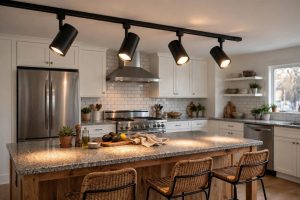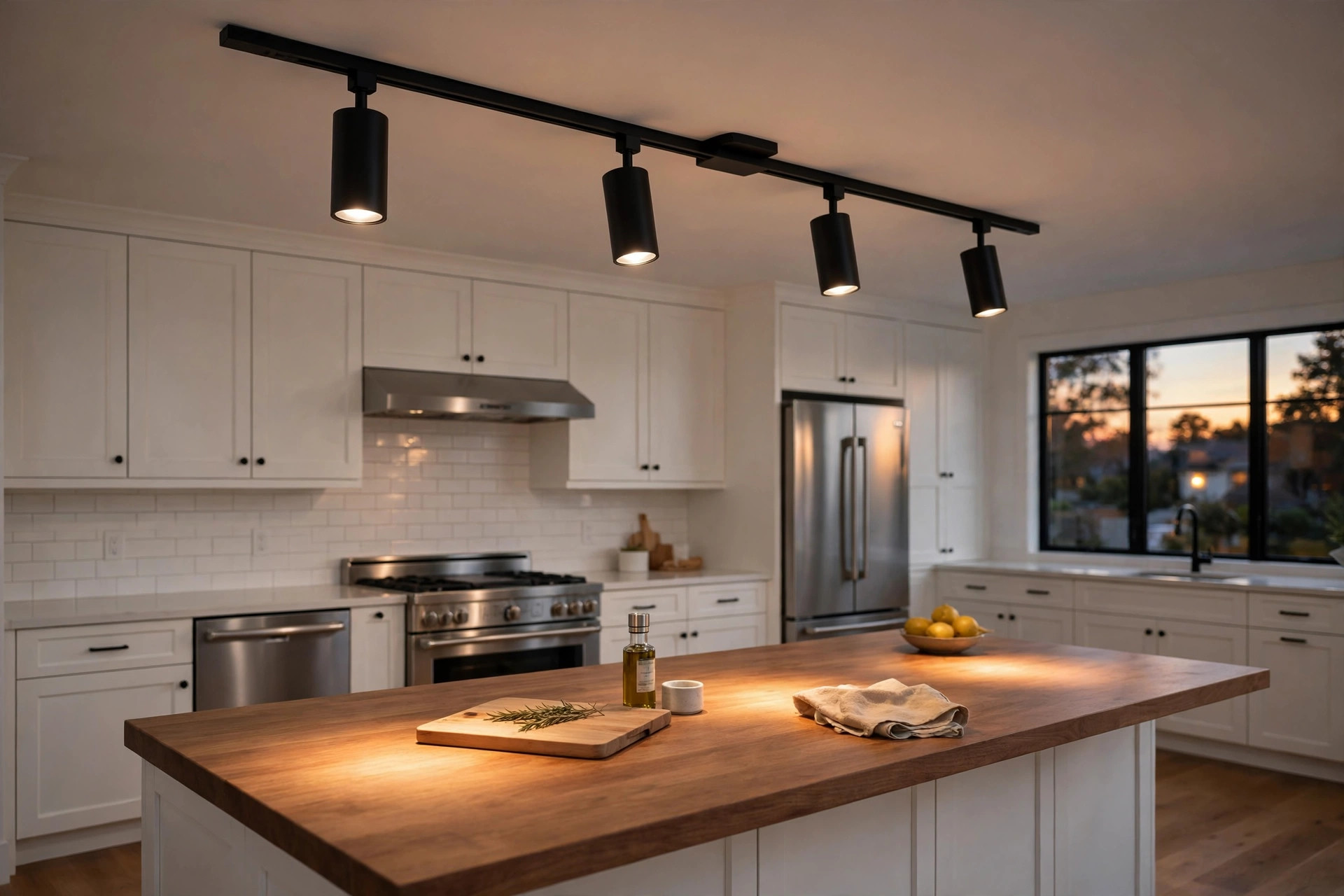
This kitchen track lighting american homes guide is written for the plain facts. Track lighting is a rail fixed to the ceiling. Small lamp heads hang from the rail. Each head can be aimed in its own direction. In an American kitchen, where the room must serve for cooking, eating, and family talk, that aim makes the light useful. One fixture can light the stove, the sink, and the table at the same time.
Many kitchens in the United States still rely on a single ceiling lamp in the center of the room. It casts shadows where work is done. The cook stands at the counter, and his own body blocks the light. Track lighting fixes this fault. The heads move. They point where the hands work. It is a practical answer to a common problem, and it has been in wide use since the nineteen seventies.
Why Kitchen Track Lighting Matters
A kitchen asks more of light than any other room. The cook must read the color of meat. He must see the edge of a knife. A child does homework at the island. Guests sit at the breakfast bar. Each task wants its own light.
Track lighting answers all of these tasks with one system. A rail of four feet can carry three or four heads. One head aims down at the cutting board. One aims across the range. One washes the cabinets with soft light. The result is a kitchen that works as well as it looks.
It also suits older houses. Many American homes have ceilings where adding new wiring is hard. A single junction box can feed a track. The rail then spreads the light across the room without new holes in the ceiling. For a renter or a buyer of an older home, this is a sound point in its favor.
What to Look for and How to Choose: Kitchen Track Lighting American Homes Guide
Start with the rail. Tracks come in fixed lengths, most often two, four, six, and eight feet. Measure the ceiling space over your work areas. The track should cover the counter run and the island, not the walk paths. Too long a rail spreads light where no work is done and wastes energy.
Look at the heads. The number of heads matters less than their type. Small cylinder heads give a clean modern look. Gimbal heads turn in a ring and aim in any direction. Step heads throw light only downward. For a kitchen, gimbal heads are the common choice, because they can be aimed at the stove today and at the table tomorrow.
Check the power. Most home tracks run on standard 120-volt line current. These accept the widest range of heads. Low-voltage tracks use a transformer and smaller lamps, but the transformer is one more part that can fail. For most kitchens, line-voltage track is the simpler choice.
Check the finish. Brushed nickel, matte black, and white are the common finishes. White rails fade into a white ceiling. Black rails stand out against light paint and suit modern kitchens. Nickel matches steel appliances. Pick the finish that fits what is already in the room.
Read the label for compatibility. Track standards are not all the same. The three common types are H, J, and L tracks. A head made for one type will not fit another. Buy the track and the heads from the same standard. This detail, found at the Home Depot track lighting page, saves many returns.
Types and Options
Line-voltage track is the standard in American kitchens. It runs straight from the house wiring through a simple connector. Heads are cheap and easy to find. Dimming works with a common wall dimmer, though the dimmer and the lamps must be matched.
Monorail track is a cousin. It bends in soft curves and hangs from small cables. It is used in modern homes where the ceiling line is part of the design. It costs more and the heads cost more. It suits a new kitchen where style is the first aim.
Cable track is two thin cables strung across the ceiling with the heads clipped on. It is light in look and suits high ceilings. It is less common in kitchens because steam and grease from cooking collect on exposed parts.
LED track heads are now the common lamp. They use far less power than the old halogen heads and stay cool. The U.S. Department of Energy explains the basics of LED lamps and their long life on the Energy Star site, and its facts are worth reading before you buy. Many heads now have the LED built in, which means no bulb to change for years. When it fails, the whole head is replaced. Choose heads with a stated life of twenty five thousand hours or more.
The color of the light matters. Warm white, around 2700 Kelvin, gives food and wood a natural look. Cool white, above 4000 Kelvin, makes a kitchen feel like a laboratory. For most American homes, warm white is the right choice, matched to the rest of the house.
If your kitchen already has pendants over the island, track lighting can work with them rather than against them. Aim the track heads at the counters and let the pendants light the island. The mix of sources gives a room that feels planned.
Cost and Price
A basic two-head track kit costs between thirty and eighty dollars at most American retailers such as Lowe’s. A four-head kit of good quality runs from eighty to two hundred dollars. Designer heads can cost fifty dollars each or more, and a full rail of those can pass five hundred dollars before the lamps.
Installation cost is separate. If the junction box already exists where the track will go, the work is simple and takes less than an hour. Many handy homeowners do it themselves. If a new box must be cut and wired, an electrician will charge between one hundred fifty and four hundred dollars in most American cities.
LED heads cost more at the store and less over time. A halogen head uses fifty watts and burns out in two thousand hours. An LED head uses ten watts and lasts ten times as long. The savings on the electric bill and on replacement lamps pay back the price difference within a year or two in a kitchen that is used daily.
Compare the whole cost against other options before you decide. A short guide to recessed ceiling lights shows what can lights cost to add. Recessed lights give a cleaner ceiling but cost more to install. Track lighting remains the cheaper way to add light to a finished kitchen.
Care and Upkeep
Track lighting asks for little care. Dust the rail and the heads every few months. A dry cloth is enough. In a kitchen, grease from cooking rises with the heat and settles on the fixture. Wipe the heads with a cloth damp with mild soap and water twice a year. Turn off the power at the switch first.
LED heads need no lamp changes for years. When a head dims or flickers, check that it is seated firmly in the track. Heads lock into the rail with a small twist tab. A loose head makes poor contact and flickers. Push it in and twist until it clicks.
If a track runs on a dimmer, use only dimmers rated for the lamp type. An old dimmer made for incandescent lamps can make LED heads buzz. The maker Philips keeps guidance on matching dimmers to LED lamps, and the few minutes of reading pay for themselves in silence.
For greasy buildup that a cloth will not take, remove the head from the track and wash it at the sink. Let it dry fully before it goes back. Never spray cleaner into the track itself. The open slot in the rail carries power, and it must stay dry.
Safety
Track lighting in a kitchen is safe when it follows the rules. The track must be mounted to a ceiling box rated for the fixture. Do not screw a track into drywall alone. A loaded track weighs several pounds, and drywall anchors fail over time. Fix it to a joist or a rated box.
Keep the heads clear of heat. Do not aim a head at a wood cabinet from close range if the head still uses halogen lamps. Halogen lamps run hot enough to scorch wood. LED heads run cool and have no such risk, which is one more reason to choose them.
Water and electricity do not mix. Do not mount a track where steam from a pot hits it directly every day. Keep the rail at least a few feet from the range. The U.S. Department of Energy publishes general home electrical safety notes that apply here as well.
If the kitchen is on a ground floor with pipes above the ceiling, have an electrician check before cutting a new box. In older homes, wiring can be a mix of old and new, and a professional eye is worth the fee.
The design site Lumens shows track layouts that keep heads away from cabinets and heat, which is a useful visual check before you drill.
FAQ
How many track heads does a kitchen need? A good rule is one head for every four to six feet of counter that needs light, plus one for the sink. Most kitchens do well with three to five heads. More heads give finer control. Fewer heads with brighter lamps give simple coverage.
Can track lighting replace all other kitchen lights? It can be the main light in a small kitchen. In a large kitchen, it works best with other sources. Pair it with under-cabinet strips for the counters. The strips light the work surface and the track lights the room. The two together leave no dark corners.
Is track lighting out of style? Styles change, but track lighting has stayed in use for fifty years. The rails have grown slimmer and the heads smaller. Matte black and white finishes suit current kitchens. A well-aimed track looks purposeful, not dated. The Spruce lighting guides show current track designs that read as modern.
How do I aim the heads? Stand in the kitchen at night with the lights on. Aim each head so its beam lands on a work surface, not on your eyes. The sink, the stove, and the main counter are the three spots. Walk the room and check for glare in the line of sight from chairs. Adjust until the beams fall on work and not on faces.
Can I put track lighting in a rental kitchen? Often yes, if you keep the old fixture and restore it when you leave. A track can mount to the existing ceiling box. Check the lease first. Some landlords allow fixture changes with approval. Keep the old light and its screws in a box so you can put it back.
What is the difference between track and rail lighting? The terms are often swapped. Track lighting runs on a flat rail with a fixed shape. Rail lighting, or monorail, uses a bendable rail on cables. Both aim their heads the same way. Lamps Plus lists both types side by side if you want to compare looks.
A Final Word
Kitchen track lighting has earned its place in American homes by being useful. It aims light where the hands work. It fits old ceilings without much trouble. It costs less than many options and it stays in style.
Choose a track that covers your work areas. Pick heads that aim freely. Use warm white LED lamps. Mount it right and keep it clean. Follow this kitchen track lighting american homes guide, and the kitchen will be lit for the work of every day for years to come.
References
ENERGY STAR. (n.d.). Energy efficient products. https://www.energystar.gov Lamps Plus. (n.d.). Lighting and home decor. https://www.lampsplus.com Lowe’s. (n.d.). Home improvement products. https://www.lowes.com Lumens. (n.d.). Lighting and ceiling fans. https://www.lumens.com Philips. (n.d.). Lighting products. https://www.philips.com The Home Depot. (n.d.). Home improvement products. https://www.homedepot.com The Spruce. (n.d.). Home and garden advice. https://www.thespruce.com U.S. Department of Energy. (n.d.). Energy efficiency and renewable energy. https://www.energy.gov
Was this guide helpful?

About Michael Thompson
The My Garden US editorial team writes practical, in-depth home and garden guides for American homeowners — tested advice, no fluff.