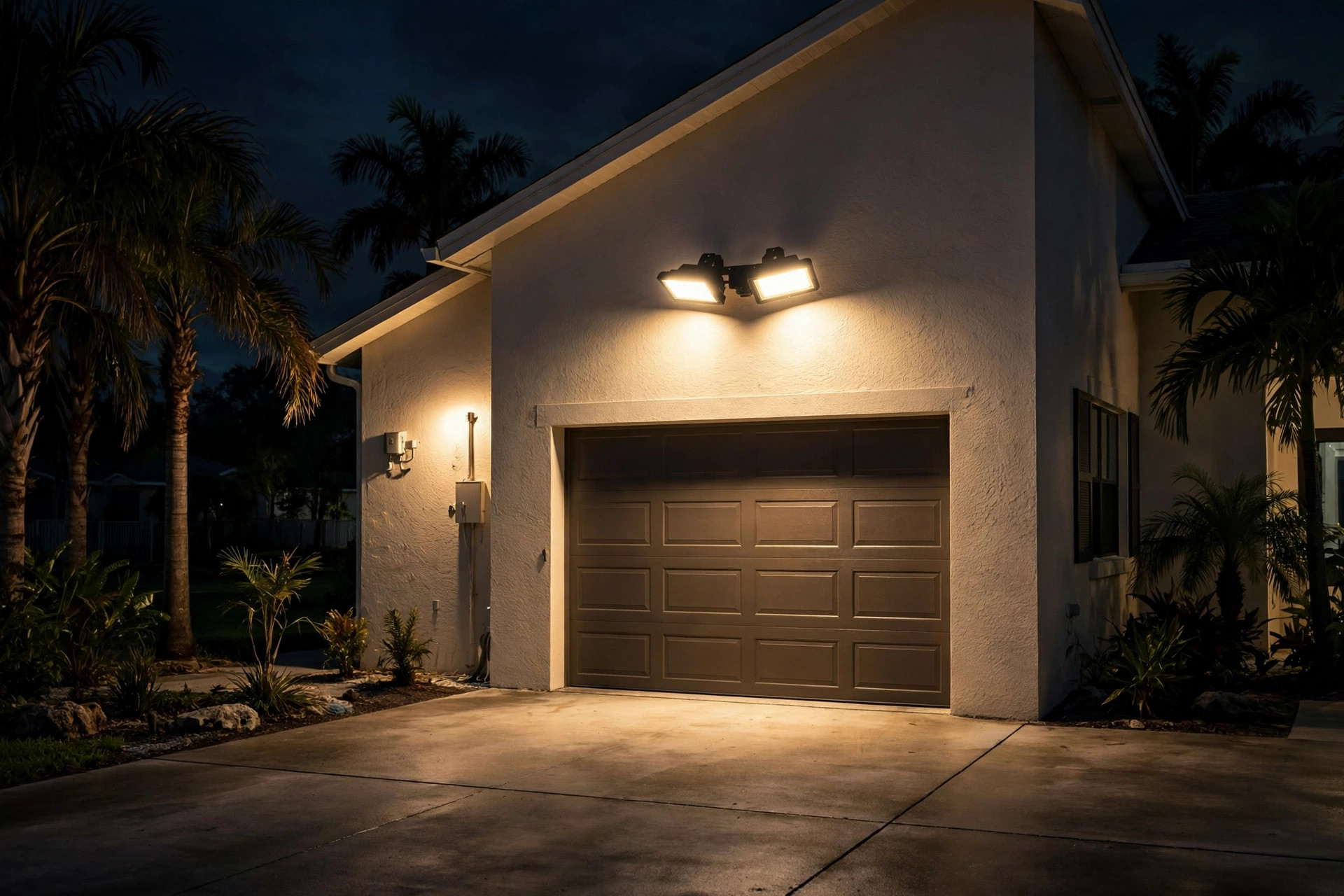

Motion flood lights florida homes usa buyers see them on every block. A small box above the garage. A twin head over the back door. The light stays dark all night. Then a car turns into the driveway, and the yard fills with white light. For Florida homes, that simple trick solves three problems at once. It greets family after dark. It warns off night visitors who do not belong. And it keeps electric bills low because the light burns only when it must.
This guide explains motion flood lights in plain terms. It covers why Florida homes need them, what to look for when you shop, the types on the market, what they cost, how to care for them, and how to keep them safe. It closes with answers to common questions and a short final word.
Why Motion Flood Lights Matter in Florida
Florida homes sit in a state of long nights and thick storms. The sun sets early in winter. In summer, heat lightning and sea squalls roll through after dark. Power lines fall. Streets go dark. A house with motion flood lights stays bright in its own yard even when the street lamps are dead. That light makes a difference.
Security is the first reason people buy. A sudden bright light startles an intruder. Most burglaries in residential areas happen after dark, and a lit yard is a poor place to hide. The Energy Star program notes that outdoor lighting works best when it is aimed and timed with care, and motion sensors do both jobs at once. They turn on when movement appears. They turn off when the yard is quiet again.
Convenience is the second reason. Florida families come home late from work, school, and church. They carry groceries. They unload cars. A motion flood light over the garage means no one has to find the switch with full hands. It also helps older relatives. A lit path from the driveway to the door lowers the risk of a fall.
Wildlife is a third reason, one that matters more in Florida than in many states. Alligators drift through drainage canals. Raccoons raid trash cans. Iguanas in south Florida knock over patio pots at night. A motion light tells you something is moving before you walk out the back door. For homes near water or woods, outdoor motion security lights florida homes owners rely on are less a luxury and more a habit.
What to Look For When You Choose: Motion Flood Lights Florida Homes Usa
Shopping for led motion flood lights florida families can trust is not hard. A few terms decide most of the purchase.
Brightness in Lumens
Lumens measure light output. A small porch spot may throw 400 lumens. A good motion flood light for a driveway throws 1,500 to 3,000 lumens. Two heads of 2,000 lumens each will cover a two-car driveway and the front walk. Read the lumen rating on the box. Ignore wattage. Wattage measures power use, and LED lamps use little power for strong light. The U.S. Department of Energy explains that lumens, not watts, tell you how bright a lamp is.
Sensor Range and Angle
The motion sensor is the heart of the fixture. Most cover 50 to 70 feet. The detection angle is usually 180 to 240 degrees. A wide angle suits a corner mount that watches two sides of a yard. A narrower angle suits a straight driveway. Check the height range too. Mount the fixture 8 to 12 feet up for best results. Too low and it trips on every passing cat. Too high and it misses a person at the gate.
Color Temperature
Color temperature is measured in kelvins. Warm white runs near 2700K. Daylight runs near 5000K. For security, 4000K to 5000K is the common pick. The cooler light looks brighter and shows color truer on a camera. Some owners prefer 3000K for a softer feel near the front porch. There is no wrong answer. Pick what suits the spot.
Weather Rating
Florida brings rain, salt air, and hurricanes. Buy a fixture rated for wet locations. The rating usually appears as IP65 or higher. Plastic housings crack in Florida sun after a few years. Aluminum housings last longer. Sealed LED heads keep out rain and the small frogs that love warm fixtures. Big retailers such as Home Depot and Lowe’s list the IP rating on every fixture page, so compare before you buy.
Timer and Sensitivity Controls
Good fixtures let you set three things: how long the light stays on after motion stops, how far the sensor reaches, and how dark the sky must be before the sensor arms. A 1-to-5 minute timer suits most driveways. A long timer suits a backyard where people gather. Sensitivity matters near streets. Set it too high and every passing car trips the light, which annoys the neighbors.
Types and Options
Motion flood lights come in a few main forms. Each suits a different corner of a Florida home.
Twin-head hardwired fixtures. The classic form. Two lamp heads on one mounting plate, wired into the house circuit. They give the most light and the longest life. They need a junction box and basic wiring skill. Most Florida homes already have a junction box over the garage or by the back door.
Single-head fixtures. Smaller and cheaper. One head, one sensor. They suit porches, side doors, and small patios where a twin head would be too much.
Solar motion flood lights. A small panel charges a battery by day. The light fires on motion by night. No wiring needed. In Florida, with long sunny days, they work better than in most states. Their light is weaker than hardwired units, and a week of cloudy weather can dim them. They suit sheds, fences, and far corners of the lot where no wire runs.
Smart flood lights. These tie into Wi-Fi. They send a phone alert when they trip. Some record video. They cost more and need a strong signal at the mounting spot. For owners who travel often, the alert is worth the price.
Many Florida buyers mix forms. A hardwired twin head covers the driveway. A solar unit covers the side fence. Wall lanterns by the front door and outdoor wall lanterns by the porch give steady light where the family gathers, while the motion units guard the dark corners. Yard accents such as landscape spot lights add beauty, and small sensor porch lights cover entries without the full flood glare.
Cost and Price
Motion flood lights are cheap security. Prices in the United States run in clear bands.
A basic single-head LED unit costs 20 to 40 dollars. It gives 800 to 1,200 lumens and a simple sensor. A mid-range twin-head unit costs 40 to 90 dollars. It gives 1,500 to 3,000 lumens, adjustable heads, and timer controls. Premium smart units with video and phone alerts cost 100 to 250 dollars.
Installation is a separate cost. If a junction box already exists, a homeowner with wiring skill can mount a fixture in under an hour. An electrician charges 100 to 200 dollars per fixture where no box exists and new wire must be run. In Florida, outdoor wiring must meet local code, and a permit may be required for new circuits. Check with the county before cutting into stucco.
Running costs are tiny. A 30-watt LED twin head that fires for one hour total per night uses about 11 kilowatt-hours per year. At Florida rates, that is under two dollars a year. Compare that with an old 150-watt halogen flood that burned all night, and the savings are plain. Efficient choices such as Philips LED heads stretch the savings further over a long service life.
Care and Upkeep
Motion flood lights ask little, but they last longer with a little care.
Clean the sensor lens twice a year. Dust and salt spray coat the lens and dull the sensor. Wipe it with a damp cloth. Do the same for the lamp heads. Dirt on the lens cuts light output without cutting power use.
Trim plants away from the fixture. A palm frond that waves in the sensor zone will trip the light all night. Leave a clear cone of air in front of the sensor. In Florida, where plants grow fast, check this each spring and fall.
Check the aim after storms. Hurricane winds tilt fixtures. A head that points at the neighbor’s window is a quarrel waiting to happen. Aim heads down and inward, toward your own doors and walks. Shield the light so the bright center falls on your ground, not across the street.
Test the sensor monthly. Walk the yard at night and note where the light trips. If it misses a dark corner, adjust the angle. If it trips on the street, lower the sensitivity. Guides at The Spruce and Lamps Plus walk through these small adjustments with pictures.
Replace nothing for years. LED heads are sealed and rated for 25,000 to 50,000 hours. At one hour a night, that is decades of service. When a unit finally fails, the whole fixture is usually replaced, since sealed LEDs are not made to be re-lamped.
Safety
Motion flood lights are electrical devices on the outside of a house. Treat them with respect.
Turn off the breaker before you open any fixture. Test the wires with a non-contact tester. Florida code requires outdoor boxes to be weather-rated, and all splices must stay inside the box. Never splice wires in the open air behind a fixture.
Mount fixtures high and out of reach. Eight to ten feet is the rule. This keeps the unit safe from tampering and keeps bright heads out of eye level for drivers and walkers.
Mind the light itself. Aim floods away from bedrooms, yours and your neighbors’. Glare that spills into a bedroom window is a nuisance and, in some Florida counties, a code issue. Many towns limit how much light may cross a property line. A quick check of local rules saves trouble later.
Watch for heat. LED heads run cool, but the housing still warms. Keep dry leaves and pine needles off the fixture. In Florida, where dry brush piles up in winter, a quick sweep of the eaves each month is good practice.
Frequently Asked Questions
How many motion flood lights does a Florida home need? Most homes need two or three. One over the garage or driveway. One at the back door. One at a dark side yard or gate. Large lots may need a fourth at the far fence. Start with the spots where people approach the house, then add coverage for dark corners.
Do motion flood lights work during Florida thunderstorms? Yes, but with limits. Heavy rain can cut sensor range, and lightning flashes may trip the sensor. A fixture with a sealed IP65 housing shrugs off rain. After a storm, check the aim. Wind often moves the heads, and a moved head may point at the street and trip on every passing car.
Will a motion light bother my neighbors? It can, if aimed wrong. Aim heads downward at your own ground. Keep the brightest pool of light inside your lot line. Use the timer so the light shuts off a minute after motion stops. If a neighbor complains, adjust the angle or lower the sensitivity. Most complaints end with one small adjustment.
Can I install one myself, or do I need an electrician? If a weather-rated junction box already exists at the spot, a skilled homeowner can do it in under an hour with the breaker off. If new wire must be run through stucco or attic space, hire a licensed electrician. Florida counties require permits for new circuits, and the work must meet the state electrical code.
Do solar motion flood lights work in Florida? They work better in Florida than in most states because the sun is strong for much of the year. Expect weaker light than a hardwired unit, and expect dim weeks during the cloudy stretch of summer storms. They suit spots far from the house where running wire is costly. For the driveway and doors, hardwired units give steadier service.
How do I stop false alarms from animals and cars? Lower the sensitivity. Raise the mount to nine or ten feet, which points the sensor over small animals. Aim the heads away from the street. Set the dusk control so the sensor arms only in full dark. If the unit still trips on every raccoon, move the fixture to watch the door, not the open yard.
A Final Word
Motion flood lights florida homes usa shoppers are really buying peace of mind. The fixture is small. The cost is low. The effect is large. A yard that answers movement with light is a yard that feels watched over, and that feeling is what a family pays for.
Buy a sealed LED unit with a good sensor. Mount it high. Aim it with care. Test it monthly. Trim the plants. The light will do its quiet job for years, turning on for the mail carrier at dusk, for the kids at night, and, when it matters, for the stranger who thought the yard was dark. Readers who want to compare fixtures and features can start with the buying guides at Lumens and the independent test reports at Consumer Reports.
References
Consumer Reports. (n.d.). Product reviews and ratings. https://www.consumerreports.org ENERGY STAR. (n.d.). Energy efficient products. https://www.energystar.gov Lamps Plus. (n.d.). Lighting and home decor. https://www.lampsplus.com Lowe’s. (n.d.). Home improvement products. https://www.lowes.com Lumens. (n.d.). Lighting and ceiling fans. https://www.lumens.com Philips. (n.d.). Lighting products. https://www.philips.com The Home Depot. (n.d.). Home improvement products. https://www.homedepot.com The Spruce. (n.d.). Home and garden advice. https://www.thespruce.com U.S. Department of Energy. (n.d.). Energy efficiency and renewable energy. https://www.energy.gov
Was this guide helpful?

About Emily Rodriguez
The My Garden US editorial team writes practical, in-depth home and garden guides for American homeowners — tested advice, no fluff.
You May Also Like
Reading Floor Lamps for Texas Homes: A Practical Buying Guide
May 14, 2026 0 views
Garage Shop Lights for Sale USA: A Plain Buyer’s Guide
August 31, 2026 0 views
Ceiling Fans Lights for Florida Homes: A Practical Guide
March 19, 2026 0 views