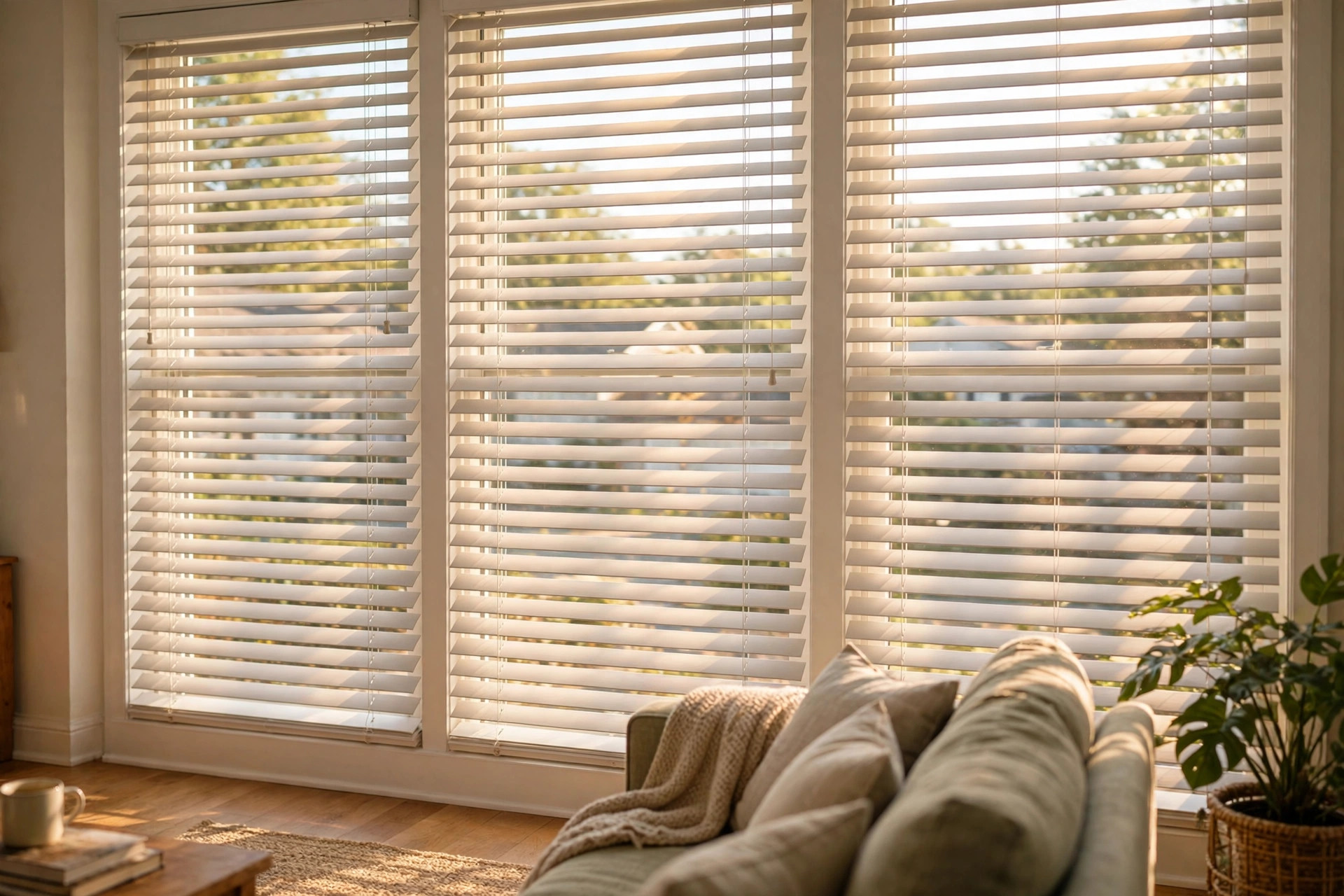

Every home has windows, and every window needs a cover. A cover gives privacy. It softens bright sun. It keeps a room cool on a hot day. Top rated faux wood blinds for USA homes meet these needs with style. They look like real wood. They cost less than real wood. They hold up in damp rooms where real wood would bend and warp. For these reasons, they rank among the most trusted window treatments in the country. This guide explains what makes a set top rated. It covers types, prices, safety, and care. Read it through before you buy.
Why Faux Wood Blinds Matter for American Homes
Wood has a warm look that suits almost any room. Real wood blinds, however, have a weakness. They react to moisture in the air. In a steamy bathroom or above a kitchen sink, real wood can swell, crack, or lose its shape. Faux wood solves this problem. It is made from man-made materials such as PVC or wood composite. These materials carry the grain and color of wood but ignore humidity.
That is why top rated faux wood blinds for USA homes sell so well from coast to coast. Homes in Florida and along the Gulf face heavy moisture. Homes in the desert Southwest face harsh sun. Faux wood stands up to both. The slats do not fade fast. They do not bow under their own weight on wide windows. They wipe clean with a cloth.
There is also the matter of price. Real wood blinds can cost two or three times as much. For a whole house, the gap is large. A family that must cover twelve windows can save hundreds of dollars by choosing faux wood. Review sites such as Consumer Reports often note that well-made faux wood ranks close to real wood for looks while winning on value. For many buyers, that mix of beauty and savings is the whole point.
What to Look For in Top Rated Faux Wood Blinds: Top Rated Faux Wood Blinds for Usa Homes
Not every set on the shelf deserves the label top rated. Good blinds share a few clear traits. Check each one before you spend your money.
Slat Size and Fit
Most faux wood blinds use 2-inch slats. This size suits standard windows and gives a classic look. For very large windows or sliding doors, 2.5-inch slats look better. They match the scale of the glass. Measure your window frame with care. An inside mount sits within the frame and looks neat. It needs exact width, down to the eighth of an inch. An outside mount covers the trim and can make a small window look larger. It is more forgiving if your tape work is rough. Measure twice and write the numbers down. Wrong sizes cause the most returns in this trade.
Corded or Cordless Operation
Old-style blinds use cords to lift the slats. Cords work, but they hang where small hands and pets can reach them. Cordless blinds lift with a gentle push or pull on the bottom rail. They are safer and they look cleaner, with no tangle of strings. If you have young children, the U.S. Consumer Product Safety Commission urges cordless or inaccessible-cord window coverings. Many top rated sets now come cordless as standard. Motorized blinds go one step further and open with a remote or a phone app. They cost more, but they suit tall windows that are hard to reach.
Finish and Color
White and off-white are the most popular finishes in the United States. They suit nearly any wall color and trim. Wood-tone finishes, such as oak or walnut, add warmth to denser rooms like studies and dens. Look for a textured grain if you want the closest match to real wood. Smooth finishes read more modern. Hold a sample chip against your trim in daylight before you order. Screen colors can lie. Design pages such as HGTV and Apartment Therapy offer simple color pairing ideas for trim and walls.
Material Quality and Warranty
Two materials dominate the market. Solid PVC slats are light, cheap, and fully waterproof. Composite slats mix wood fiber with plastic. They feel sturdier and hold a deeper grain, but they cost a bit more. Either can be top rated if built well. Check the thickness of the slats. Thin slats sag on wide spans. Check the headrail. Metal headrails outlast plastic ones. A real warranty matters too. Top makers back their blinds for several years against warping, fading, and defects. Short warranties are a warning sign.
Types and Options Worth Knowing
The basic horizontal blind is the heart of this market. Slats stack at the top when raised and tilt to tune the light. Beyond this base model, several options exist.
Routeless blinds hide the cord holes that run through each slat. The result is a cleaner face and less light leak. They cost more, but they darken rooms better. This makes them a smart pick for bedrooms and nurseries.
Cordless faux wood blinds are now common at every price level. Shoppers can find them at large retailers like Lowe’s and Wayfair, as well as at smaller blind shops. For a softer window look in some rooms, some owners pair blinds with curtains. Our guide to top rated sheer linen curtains for USA homes shows how sheers layer over blinds for a gentle, finished style.
Motorized blinds run on batteries or house power. You can set them to open at dawn and close at dusk. They suit high windows over stairwells and great rooms. Faux wood vertical blinds also exist for wide patio doors, though horizontal slats remain the norm for standard windows.
If light control is your main goal, note that no blind blocks one hundred percent of light on its own. Routeless models come closest. For a full blackout effect in a bedroom, many buyers add side channels or a curtain panel. Families with children often look at top rated cordless cellular shades for American homes as well, since cellular shades trap air and add insulation along with darkness.
Cost and Price
Faux wood blinds sit in a friendly price range. A standard ready-made set for one window often runs from thirty to eighty dollars. Custom-cut sets, made to your exact measurements, run from eighty to one hundred fifty dollars per window or more. Wide windows and motorized lifts push the price higher.
Where you shop changes the price. Big home stores carry stock sizes at low prices. Online sellers offer custom sizes with free samples. Specialty blind shops cost more but provide in-home measuring and fitting. Guides from The Spruce and Bob Vila compare sellers and explain where the value lies. Ratings roundups, including those from Consumer Reports, help you see which brands hold up over time.
Do not forget fitting costs. Hanging a blind is a simple job for most adults. It takes a drill, a level, and about twenty minutes per window. If you hire help, expect a service call fee plus a per-window charge. For a full house, self-fitting can save several hundred dollars. Many retailers, including IKEA, post clear fitting videos that walk you through each step.
Care and Upkeep
One of the best traits of faux wood is easy care. Dust the slats once a week with a dry cloth or a duster. For sticky spots, wipe with a damp cloth and a drop of mild soap. Rinse the cloth and wipe again. Do not soak the headrail. Do not use strong cleaners, bleach, or scouring pads. They can dull the finish.
Tilt the slats fully closed before dusting. This gives you a flat face to clean. Work top to bottom so dust falls onto slats you have not cleaned yet. In kitchens, a light film of grease can build up over months. A damp cloth with warm water handles it. If a slat cracks, many brands sell single replacement slats. Keep your order papers so you can match the color code.
Check the tilt wand and cords twice a year. Wands should turn smoothly. If a cord frays, replace it or call the maker. Loose brackets should be tightened before the blind drops. With this small effort, a good set lasts ten years or more in normal use.
Safety First
Window covering safety deserves real attention in any home with children or pets. Loop cords have caused tragic accidents. The safest choice is a cordless blind with no loops at all. If you keep corded blinds, fit cord cleats high on the frame and wrap cords out of reach. Never place a crib or a child bed under a window with hanging cords.
The U.S. Consumer Product Safety Commission keeps current rules and recall lists for window coverings. Check its site before you buy, and register your product with the maker so you hear about recalls. Mount every blind with the brackets and screws that come in the box. A heavy blind on weak anchors can fall. On wide windows, use a center support bracket to stop sag and stress.
Lead safety is a smaller worry with new blinds, but it is worth a note. Very old blinds made before modern rules may carry lead in paint or cords. If your home still has blinds from decades past, replace them. New faux wood blinds sold in the United States meet current safety standards.
Energy and Comfort
Window coverings do more than please the eye. They change how a room feels. In summer, closed light-colored slats bounce sun back out and cut heat gain. In winter, they add a thin barrier that slows heat loss through glass. ENERGY STAR notes that smart use of window attachments can trim heating and cooling waste in many homes.
For the best effect, close blinds on sun-struck windows during the hottest hours. Tilt slats upward in summer so heat rises away from the glass. In winter, open south-facing blinds on sunny days to catch free warmth, then close them at dusk. These small habits cost nothing and add up over a season.
Frequently Asked Questions
Are faux wood blinds better than real wood blinds? Neither is better in every case. Faux wood wins on price, moisture resistance, and easy care. Real wood wins on natural grain and a rich feel that plastic cannot fully copy. For bathrooms, kitchens, and humid climates, faux wood is the wiser pick. For a formal living room in a dry climate, real wood has its charms. If you lean toward real wood, our machine washable real wood blinds buying guide covers what to know before you buy.
Can faux wood blinds go in bathrooms and kitchens? Yes. This is one of their main strengths. PVC slats do not absorb water, so steam and splashes do not harm them. Wipe them dry after heavy steam if you wish, but warping is not a concern. Just avoid placing them where a gas burner or open flame can touch them.
How long do faux wood blinds last? A well-made set lasts eight to fifteen years in a normal home. Sun is the main enemy. South-facing windows wear any blind faster. Quality slats with UV protection hold their color longer. Cheap thin slats may yellow or bow within a few years.
Are they hard to install? No. Most adults can fit a blind with basic tools. The box holds brackets, screws, and a paper template. An inside mount takes the most care because the fit is tight. Watch one fitting video first, and the job goes fast. If drilling into tile or metal, use the right bit and anchors.
Do faux wood blinds block light fully? They block most light but not all. Small gaps at the sides and the cord holes let thin lines through. Routeless models cut these lines down. For a truly dark room, add blackout curtains or side channels over the blinds.
How do I clean very dusty blinds? Take the blind down and lay it on a towel. Wipe each slat with a damp cloth. For deep grime, a bathtub soak in warm water with mild soap works for PVC slats. Dry fully before rehanging. Never soak a blind with a fabric valance or a wood headrail.
A Short Final Word
Choosing window coverings should not be hard. Decide your size and mount. Pick cordless for safety. Choose a finish that matches your trim. Buy from a maker with a real warranty. With those four steps, top rated faux wood blinds for USA homes will serve you well for years. They bring the look of wood, the toughness of plastic, and a price most budgets can bear. Measure well, fit them straight, and enjoy the light on your own terms.
References
Apartment Therapy. (n.d.). Home design ideas and inspiration. https://www.apartmenttherapy.com Bob Vila. (n.d.). Home improvement advice. https://www.bobvila.com Consumer Reports. (n.d.). Product reviews and ratings. https://www.consumerreports.org ENERGY STAR. (n.d.). Energy efficient products. https://www.energystar.gov HGTV. (n.d.). Home and garden ideas. https://www.hgtv.com IKEA. (n.d.). Home furnishings. https://www.ikea.com Lowe’s. (n.d.). Home improvement products. https://www.lowes.com The Spruce. (n.d.). Home and garden advice. https://www.thespruce.com U.S. Consumer Product Safety Commission. (n.d.). Product safety information. https://www.cpsc.gov Wayfair. (n.d.). Furniture and home goods. https://www.wayfair.com
Was this guide helpful?

About David Wilson
The My Garden US editorial team writes practical, in-depth home and garden guides for American homeowners — tested advice, no fluff.
You May Also Like
Best Window Treatment Installation Services Near Me
January 5, 2026 0 views
Best Pinch Pleat Drapes for Humid Climates
February 10, 2026 0 views
Budget Friendly Pet Friendly Curtains Buying Guide
June 6, 2026 0 views