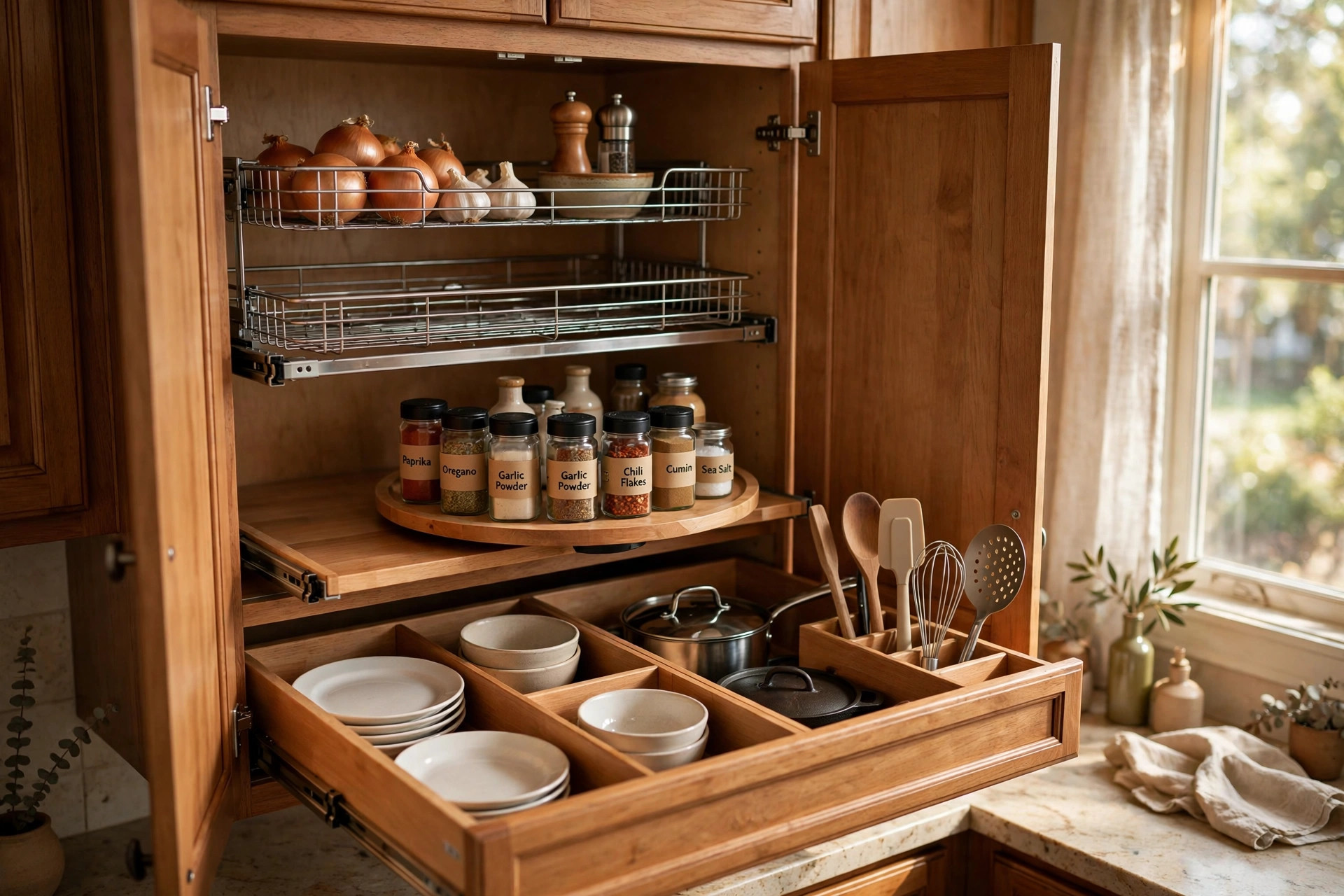

This kitchen cabinet organizers reviews and buying guide explains what these products do, which types suit which cabinets, and how to pick a good one. Kitchen cabinets hold pots, pans, plates, cups, spices, and small tools. When space is not planned well, the cabinet becomes a crowded box. Items pile on top of each other. The pot you need sits under three others. This guide helps you fix that. It walks through reviews, types, costs, care, and safety so you will know what to buy and what to skip.
Why Kitchen Cabinet Organizers Matter
A kitchen works best when every item has a place. Organizers give you that order, turning deep, dark shelves into space you can reach. Many American kitchens have base cabinets that are 24 inches deep. The back half of such a shelf is hard to see and hard to reach. A pull-out shelf or a turntable brings those items to you.
Good organization also saves time. Cooking moves faster when spice jars stand in rows and pans sit in their own slots. You stop digging through a stack and stop buying a second jar of cinnamon because you could not see the first one.
Organizers protect your things too. Plates chip less when they rest in a rack instead of a tall stack. Pans scratch less when they sit upright in a divider. Glass jars break less when they are held in a tray. Over years, this care saves real money.
There is a safety angle as well. A heavy pot can fall when it slides off a tall pile. A sharp knife can hide under a pan and cut a hand. Orderly cabinets lower these risks. For homes with older people or small children, a tidy cabinet is a safer kitchen.
What to Look for When You Buy: Kitchen Cabinet Organizers Reviews and Buying Guide
Before you buy anything, study your own cabinets. Open every door. Take out the shelves that you can move. Measure the inside width, depth, and height of each cabinet with a tape measure. Write the numbers down. Many organizers are sold in standard widths such as 12, 15, 18, or 24 inches. If your cabinet opening is smaller than the product, it will not fit. A common mistake is to measure only the door. The inside frame is what matters.
Materials
Kitchen cabinet organizers come in several materials, each with strengths.
Steel wire racks are strong and light. Many are coated with chrome or epoxy to resist rust. They suit pots, pans, and cans. Plastic organizers are light and cheap. They work well for spices, packets, and small tools. Wood organizers, often bamboo or maple, look warm and natural. They suit drawers and plate racks. Metal pull-out units with soft-close slides feel smooth and carry the most weight.
Pick a material that fits the job. A plastic tray will bend under a stack of cast iron skillets. A wire rack is fine for canned food but may let small spice bottles tip through its gaps.
Weight Rating
Check the weight rating before you load an organizer. Cheap pull-out shelves may carry only 25 pounds. Strong ones carry 100 pounds or more. Think about what will sit on the unit. A shelf that holds dinner plates, mixing bowls, and a slow cooker can reach 60 pounds fast. Reviews on Good Housekeeping and Wirecutter often test how much weight a unit holds before it bends or the slides stick.
Installation
Some organizers need no tools. Turntables, tiered shelf risers, and under-shelf baskets simply drop into place. Others need a drill. Pull-out shelves and door-mounted racks usually screw into the cabinet floor or door. Renters should choose no-drill options to avoid damaging the cabinets. If you own your home, screwed units last longer and hold more weight.
Fit for Cabinet Style
Corner cabinets, blind cabinets, and under-sink cabinets each need special products. A standard rectangle shelf will not work in a corner. This buying guide covers those cases below.
Types of Kitchen Cabinet Organizers
Pull-Out Shelves and Drawers
Pull-out shelves are the most useful type for deep base cabinets. They mount on smooth slides and roll out when you pull the handle. You can see and reach every item on the shelf. Many reviewers rank them as the top choice for lower cabinets. Full-extension slides are best because the shelf comes all the way out. Half-extension slides leave the back third hidden.
Two-tier pull-out units stack two baskets on one frame. They double the storage in a tall cabinet. Soft-close slides cost more but feel better and protect the cabinet.
Lazy Susans and Turntables
A lazy susan is a round disc that spins on a base. You place items around it and turn it to reach the back ones. Kidney-shaped and D-shaped models fit corner cabinets. They make the dead corner space usable. For corner options, see our guide to best rotating lazy susan turntables for Texas homes.
Round turntables suit pantry, spice, and upper cabinets. They come in plastic, wood, and metal. Raised rims keep bottles from sliding off, and two-level models double storage on one shelf.
Door-Mounted Racks and Baskets
The inside of a cabinet door is wasted space in most kitchens. Narrow wire racks screw onto the door and hold spices, wraps, lids, and small bottles. Measure the depth of the door plus its handle clearance before you buy. The rack must clear the shelves when the door closes. Door racks are a cheap way to add storage without changing the cabinet.
Tiered Shelves and Risers
A shelf riser is a small stand that creates a second level inside a cabinet. You put short items under it and tall items on it. Risers help with canned food, glasses, and spice jars. They are cheap, need no tools, and move easily when you rearrange the kitchen. Corner risers fit into the back corner of a cabinet and use space that is often empty.
Drawer Organizers and Dividers
Deep drawers hold utensils, tools, and wraps. Dividers split the drawer into rows. Adjustable bamboo dividers press against the drawer walls with springs. They fit many drawer sizes. For cutlery, a fixed tray with slots works best. Lid organizers hold pot lids upright so they stop sliding around. These small products cost little and change the feel of a drawer at once.
Under-Sink Organizers
The cabinet under the sink is a hard space. Pipes run through the middle. The floor is often damp. Two-tier sliding organizers fit around the pipes and hold cleaning bottles where you can reach them. Choose rust-proof materials like plastic-coated steel or hard plastic. Never store food or cooking tools under the sink.
Vertical Dividers and Plate Racks
Vertical dividers hold baking sheets, cutting boards, and trays upright. They stop the tall stack that topples when you pull one item. Plate racks with vertical pegs hold plates on edge. This layout saves space and chips fewer plates. Wood pegboard inserts let you move the pegs to fit your own dishes.
Reviews: What Buyers Praise and Complain About
Across many review sites, certain themes repeat. Buyers praise pull-out shelves for ending the deep-cabinet problem and lazy susans for corner cabinets.
Complaints repeat too. The most common complaint is a poor fit from wrong measurements. The second is weak slides that stick after a few months. The third is rust on cheap chrome wire in damp under-sink cabinets.
To avoid these problems, read reviews that mention your cabinet size and look for reviews with photos after six months of use. A mid-price unit from a known maker often lasts the longest per dollar. Test labs at Consumer Reports publish durability notes that help here, and buying guides at The Spruce, Bob Vila, and Family Handyman compare budget and premium models side by side.
Cost and Price Ranges
Kitchen cabinet organizers range from a few dollars to several hundred. Tiered risers and turntables cost 10 to 30 dollars. Door-mounted racks cost 15 to 40 dollars. Drawer dividers and cutlery trays cost 10 to 35 dollars. These small products give the best value per dollar in most kitchens.
Single pull-out shelves cost 40 to 120 dollars depending on width and slide quality. Two-tier pull-out units cost 80 to 200 dollars. Corner lazy susan systems cost 60 to 250 dollars. Custom-fit pull-out shelving, installed by a pro, can cost 200 to 400 dollars per cabinet.
Start with the cabinets you open most. The base cabinet near the stove and the spice cabinet give the biggest daily gain. You can add more later.
Watch for sales at large home stores. Home Depot and Lowe’s run storage sales in January and late summer. Online sellers like Wayfair and IKEA often bundle organizers with kitchen lines at a lower price.
Care and Upkeep
Organizers need little care, but a small routine keeps them working for years. Wipe wire racks with a damp cloth every few months. Grease from cooking settles on the wires and makes them sticky. Dry the racks fully after wiping so chrome does not rust.
Clean the slides on pull-out units once a year. Pull the shelf out, wipe the metal tracks with a damp cloth, and let them dry. A drop of silicone spray on the track keeps the glide smooth. Do not use cooking oil. It turns gummy and attracts dust.
Check screws twice a year. The screws that hold a pull-out frame or a door rack can loosen as the cabinet doors move. Tighten them with a screwdriver. If a screw hole has stripped, move the screw to a fresh spot or use a small wood plug.
Replace cracked plastic trays before they break under weight and drop glass jars. Keep loads within the rating printed on the box, since overloading bends wire shelves slowly over months.
For layout ideas that keep counters clear too, browse the storage guides at Apartment Therapy.
Safety
Kitchen organizers are safe when they are installed well and loaded within their limits. Follow these rules.
First, mount heavy units to studs or solid cabinet frames where possible. A pull-out shelf full of pots can weigh 70 pounds. If its screws sit in thin particle board, the unit can pull free. Use the screws that come with the product. They are sized for the job.
Second, keep heavy items low. Store cast iron, mixers, and large pots in base cabinets, not on high shelves. A heavy item on a high riser can tip forward when you pull it out.
Third, watch sharp edges. Cut the plastic ties and twist wires that hold a new product in its box. Some wire racks have sharp ends where the wire was cut. File any sharp point or cover it with a small cap.
Fourth, keep chemicals apart from food. Under-sink organizers should hold only cleaning supplies. Never store snacks, spices, or cooking oil under the sink, even on a tidy organizer.
Fifth, protect children. Mount door locks on cabinets that hold knives, cleaners, or heavy appliances. A pull-out shelf full of pots is heavy enough to hurt a small child if it is pulled out and climbed on. Safety standards and recall notices are published by the U.S. Consumer Product Safety Commission, which is worth checking before you buy.
Frequently Asked Questions
How do I measure my cabinet for an organizer?
Measure the inside of the cabinet, not the door. Record width, depth, and height, and note any pipes, hinges, or frames that stick out. Compare with the product size before you order, and allow a quarter inch of clearance on each side.
Are pull-out shelves worth the cost?
For deep base cabinets, yes. They are the single most praised product in kitchen cabinet organizers reviews. They end the problem of lost items at the back of a deep shelf. For shallow upper cabinets, a riser or turntable may serve just as well for less.
Can I install organizers without drilling?
Yes. Turntables, risers, under-shelf baskets, and tension-mounted dividers need no tools. Door racks and pull-out shelves need screws. If you rent, stick to the no-drill options. Many renters get a full refresh with turntables, risers, and drawer dividers alone.
What is the best organizer for a corner cabinet?
A kidney-shaped or D-shaped lazy susan fits most corner cabinets. Two-tier models use the tall space well. For blind corners, a pull-out swing system reaches into the dead space. Measure the corner carefully because these units must clear the door frame as they turn.
How much weight can a pull-out shelf hold?
It depends on the model. Light models hold 25 to 50 pounds. Strong models hold 75 to 100 pounds. The product box or web page lists the rating. Stay under it. A shelf of dinner plates and bowls can weigh 50 pounds before you add a single pot.
Do organizers work in small kitchens?
Yes, and they matter more there. In a small kitchen, every inch counts. Door racks, risers, and vertical dividers add storage without changing the cabinets. A rolling storage carts reviews and buying guide can also help, since a small cart adds a work surface and storage that moves where you need it. For ideas matched to American kitchens, read our list of the best kitchen cabinet organizers for American homes.
Final Word
A kitchen cabinet organizer is a small purchase with a daily payoff. Measure your cabinets, pick the type that fits your worst cabinet first, read long-term reviews, and stay within the weight rating. Your cabinets will be calmer, your cooking faster, and your pots longer lasting.
References
Apartment Therapy. (n.d.). Home design ideas and inspiration. https://www.apartmenttherapy.com Bob Vila. (n.d.). Home improvement advice. https://www.bobvila.com Consumer Reports. (n.d.). Product reviews and ratings. https://www.consumerreports.org Family Handyman. (n.d.). DIY home repair and maintenance. https://www.familyhandyman.com Good Housekeeping. (n.d.). Product reviews and home advice. https://www.goodhousekeeping.com IKEA. (n.d.). Home furnishings. https://www.ikea.com Lowe’s. (n.d.). Home improvement products. https://www.lowes.com The Home Depot. (n.d.). Home improvement products. https://www.homedepot.com The Spruce. (n.d.). Home and garden advice. https://www.thespruce.com U.S. Consumer Product Safety Commission. (n.d.). Product safety information. https://www.cpsc.gov Wayfair. (n.d.). Furniture and home goods. https://www.wayfair.com Wirecutter. (n.d.). Product reviews from The New York Times. https://www.nytimes.com/wirecutter
Was this guide helpful?

About Michael Thompson
The My Garden US editorial team writes practical, in-depth home and garden guides for American homeowners — tested advice, no fluff.
You May Also Like

Luxury Stackable Shoe Storage Boxes for Sale: A Buyer’s Guide
March 5, 2026 0 views
Garage Workbench With Storage Reviews and Buying Guide
June 14, 2026 0 views
Stackable Ottoman Storage Benches Buying Guide
March 11, 2026 0 views