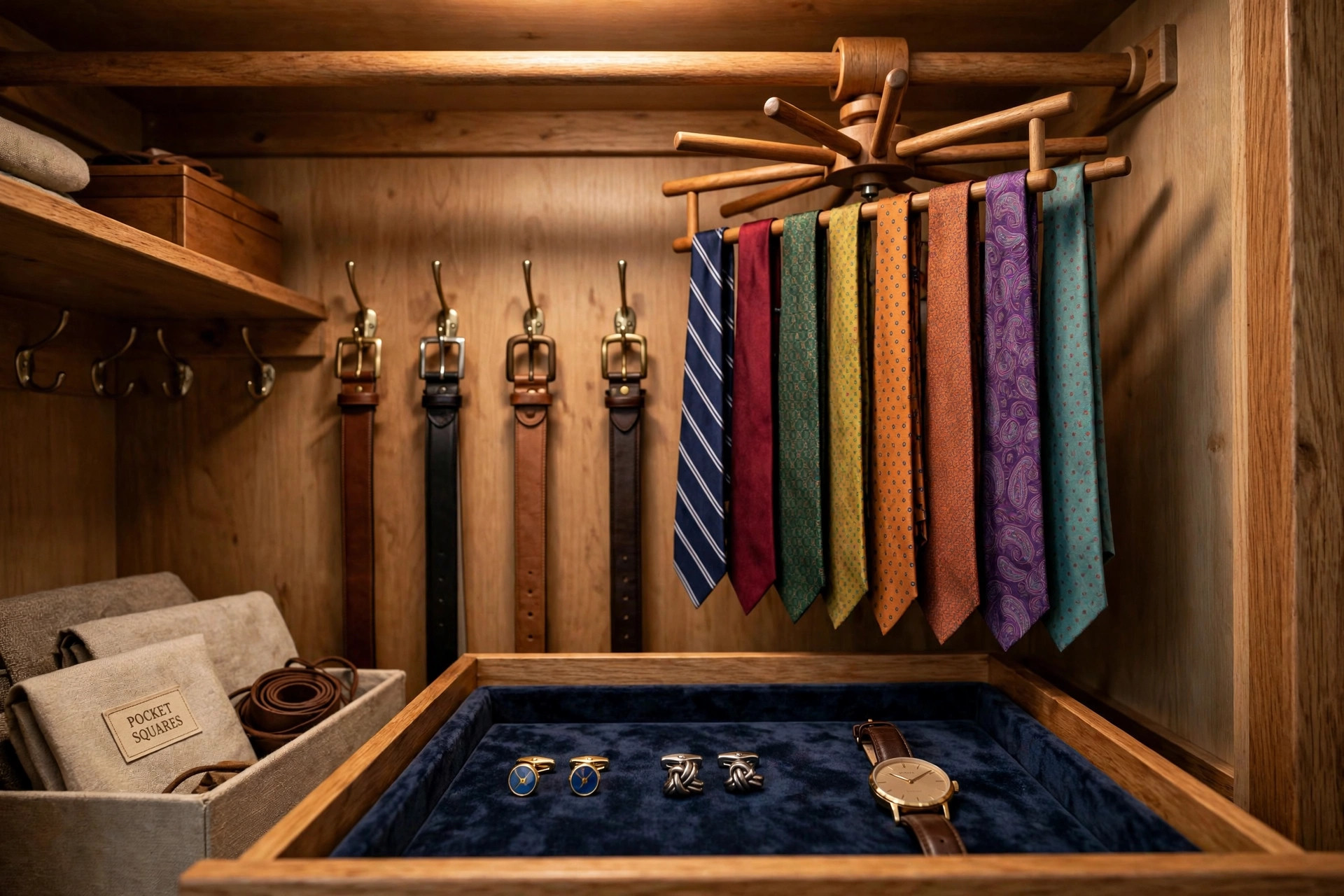

A search for a tie belt and accessory organizers price comparison usa can be a long road. Prices shift from one store to the next, and the range of styles is wider than most shoppers expect. This guide lays out the true cost of tie, belt, and accessory organizers sold across the United States. It also shows how to choose well, where to look, and how to care for what you buy. Every price below reflects typical retail ranges seen at major American stores, from discount shelves to premium closet lines.
Why Tie, Belt, and Accessory Organizers Matter
A tie rolled in a drawer will crease. A belt tossed on a chair will crack at the fold. A small pile of cufflinks, watches, and pins will drift to the bottom of a drawer and vanish. Organizers fix all three problems at once. They keep each item in its own place, visible and easy to reach. They also protect the leather, silk, and metal from damage.
Good order in a closet saves time each morning. A man with twenty ties can see all of them in one glance on a rotating rack. A belt hung by its buckle keeps its shape far longer than one coiled on a shelf. Small accessories stored in lined trays stay clean and easy to find. These gains may seem small, but over months they add up to real savings. Ties and belts that are stored well last years longer than those that are not.
Families benefit as well. In a shared closet, an organizer marks clear space for each person. Children learn to hang their school ties and belts instead of dropping them on the floor. Guests who stay over find spare hooks and trays ready for their use. Order in the closet tends to spread to the rest of the home. Closets are often the first room shoppers organize when they decide to get their homes in shape, and many move on to closet organizer systems for the full treatment.
How to Choose the Right Organizer: Tie Belt and Accessory Organizers Price Comparison Usa
Start with a count. Lay out every tie, belt, watch, pin, and cufflink you own. Count them by type. A holder that fits twelve ties will not serve a man who owns forty. Buy for the number you have today, plus a little room to grow. Most makers list capacity right on the box or the web page, so check that number before you compare prices.
Next, study your closet. Measure the width of the rod, the depth of the shelves, and the space inside the door. Door-back racks need a door that closes with room to spare. Wall-mounted racks need a solid stud or a good anchor. Rotating tie racks need clearance to spin without hitting shirts or coats. A tape measure is the cheapest tool in this whole project. Use it first.
Think about the finish. Cedar wood resists moths and keeps a light, clean smell. Chrome and steel fit a modern closet and clean with a damp cloth. Velvet-lined trays grip small items so they do not slide. Fabric drawer boxes fold flat when not in use, which suits small apartments. The right finish is the one that matches your home and your habits. A guide on corner closet organizers can help you match finishes across the whole closet.
Types and Options
Rotating tie racks are the classic choice. A motorized or manual carousel hangs from the rod or mounts under a shelf. Most hold twenty to thirty-five ties and turn with a touch. Manual models cost less and need no batteries. Motorized models turn on their own but cost more and can break. The container store and similar closet shops carry both kinds in wide ranges.
Pull-out belt racks work on a smooth slide. The rack pulls forward, you take the belt you want, and you push it back. Hooks on the rack hold each belt by its buckle. This style suits deep closets where a fixed rack would hide behind clothes. Prices run a bit higher than simple fixed racks because of the sliding hardware.
Over-the-door organizers hang on two hooks and need no tools. They suit renters and dorm rooms. Most combine tie hooks, belt hooks, and small pockets for accessories in one panel. They are among the cheapest options, but they can rattle when the door moves. They also block the door from closing flush in tight frames.
Drawer trays and boxes sit inside a dresser drawer or on a shelf. Velvet or linen trays hold watches, cufflinks, rings, and pins in separate wells. Stackable boxes with lids keep dust off seasonal items. These are the best choice for small valuables that should stay out of sight. For locking options, look at the advice in waterproof jewelry storage boxes for ideas that carry over to belt buckles and watch cases.
Wall-mounted peg rails and hook boards let you build your own layout. You hang the hooks where you want them, as many as you need. Solid wood rails with brass hooks look fine in an open dressing room. This route costs little but asks for a drill and a level.
Combo units merge several functions in one frame. A single hanging panel may hold ties on one side, belts on the other, and a tray on top for watches. These are a smart buy for a first apartment or a small closet. Shoppers at ikea will find several combo styles at entry prices.
Cost and Price: The Comparison
This is the heart of our tie belt and accessory organizers price comparison usa. Prices are grouped by type, from budget to premium. All figures are typical United States retail ranges before tax and shipping.
Over-the-door panels are the cheapest class. Simple fabric panels with hooks run about eight to fifteen dollars. Sturdier wood and metal panels run fifteen to thirty dollars. Stores like walmart and target keep these on the shelf year round, and prices often drop during back-to-school and January sales.
Drawer trays and boxes sit in the middle. Single velvet trays cost about ten to twenty dollars. Sets of three or four stackable boxes cost twenty to forty dollars. Linen and bamboo sets cost more than fabric ones. Gift sets with printed boxes may reach fifty dollars at amazon during the holiday season.
Rotating tie racks show the widest range. Manual carousels cost fifteen to thirty dollars. Battery-powered models cost thirty to sixty dollars. Premium hardwood carousels with felt-lined arms can reach seventy to ninety dollars. Shoppers should check the weight limit. A rack that sags under thirty ties is no bargain at any price.
Pull-out belt racks cost more because of their hardware. Basic slide-out racks run twenty to forty dollars. Heavy-duty ball-bearing slides run forty to eighty dollars. Wall-mounted belt racks without slides are cheaper, at twelve to twenty-five dollars, and the tool aisles at homedepot and lowes carry them near the closet parts.
Wall-mounted peg rails are among the cheapest per hook. A six-hook pine rail costs eight to fourteen dollars. A twelve-hook oak or walnut rail costs twenty to forty-five dollars. Brass and bronze hooks cost more than steel ones. Add the cost of wall anchors if your wall is drywall.
Combo units run twenty to sixty dollars depending on size and material. Fabric combo panels sit at the low end. Wood and metal combo frames sit at the high end. Custom closet companies price these much higher, but their units are built to fit one exact closet and are not really comparable.
When you compare prices, check three things besides the sticker. First, check the capacity. A twenty-dollar rack that holds forty ties costs less per tie than a twelve-dollar rack that holds twelve. Second, check the mounting cost. A rack that needs a handyman to install it is not really a twenty-dollar rack. Third, check the warranty. A one-year warranty on a sixty-dollar motorized carousel is worth real money if the motor fails.
Shipping can change the math. Small organizers often ship free from big online stores. Large wood racks may add ten to twenty dollars in freight. Local pickup at a home store avoids the fee and lets you see the finish before you buy. Seasonal sales move prices by twenty to forty percent. January and July are strong months for closet goods in most states.
Care and Upkeep
Cedar and hardwood racks need little care. Dust them with a dry cloth once a month. If cedar loses its scent, a light sanding with fine paper brings it back. Never soak wood racks in water. A damp cloth followed by a dry one is enough.
Metal racks and chrome hooks do well with a soft cloth and mild soap. Dry them fully to stop spots. Check screws twice a year and tighten what has worked loose. A drop of light oil on a stiff carousel bearing will keep it turning smooth.
Fabric panels and drawer boxes can be vacuumed with a soft brush head. Spot clean stains with a mild soap and water, then air dry. Do not put fabric organizers in a washing machine unless the label says it is safe. Velvet trays pick up lint, so a lint roller kept in the drawer is a wise buy.
Leather belt loops and straps on some organizers need leather care. A light conditioner once or twice a year keeps them soft. Keep leather parts out of direct sun, which dries and cracks them. If a belt hook bends, bend it back gently with pliers rather than forcing it.
Store spare organizers flat in a dry place. Stack trays with tissue between them so the lining does not press flat. Hang empty racks rather than piling them in a box, which can bend the arms. Simple guides from thespruce and familyhandyman offer more detail on closet care through the year.
Safety
Most tie, belt, and accessory organizers are safe by design, but a few points deserve care. Over-the-door hooks can scratch door paint and dent thin hollow doors. Felt pads behind the hooks stop most marks. Check the door weight rating before you hang a loaded panel.
Wall-mounted racks must hit a stud or use proper anchors. A rail full of belts is heavier than it looks. A rail that pulls out of drywall can damage the wall and the items on it. If you are not sure where the studs are, a cheap stud finder removes the guesswork.
Motorized carousels use small batteries or plug-in adapters. Keep cords away from water and do not overload the outlet. Take batteries out if the unit will sit unused for months, since old batteries can leak.
Small trays with rings, pins, and cufflinks should sit out of reach of small children. Pins and tie bars are sharp. Locking boxes add peace of mind in a busy home. Keep heavy belt racks low enough that a child cannot pull them down.
Frequently Asked Questions
How many ties should an organizer hold? Buy for the count you have plus room to grow. Most men own between fifteen and thirty ties. A twenty-four or thirty-five tie rack covers that range. If you own more than forty, consider two racks rather than one overloaded rack.
Are motorized tie racks worth the extra cost? They are a comfort buy, not a need. A manual carousel does the same job for half the price. Motorized models suit collectors with many ties who want one-touch turning. Check the battery type before you buy, since some use costly specialty cells.
Can I mount a belt rack on a hollow door? Light over-the-door panels work on most doors. Screwed-in racks should not go on hollow doors, since the screws will not hold. Use a solid door, a wall stud, or a closet side panel instead.
What is the best organizer for a small closet? An over-the-door panel or a combo hanging unit gives the most storage per inch. Both use dead space on the door or rod. Drawer trays work well if you have a dresser but no rod space.
How do I stop ties from slipping off hooks? Choose hooks with a slight upward tip or a non-slip coating. Velvet-covered hooks grip silk well. Hang ties with the wide end down so the weight sits on the hook. Do not crowd hooks, since packed hooks push ties off.
Should I buy a set or separate pieces? A set costs less per piece and matches in finish. Separate pieces let you buy exactly what you need and upgrade one part later. For a first closet, a set is the simpler buy. For a large wardrobe, separate pieces fit better.
A Final Word
A tie belt and accessory organizers price comparison usa comes down to three questions. How many items do you own. How much space do you have. How much do you want to spend per item stored. Answer those three and the right rack picks itself. Start with a count and a tape measure, compare capacity against price, and buy the sturdiest unit your budget allows. A well-kept closet pays you back every morning, one neat tie and one straight belt at a time.
References
Amazon. (n.d.). Online shopping. https://www.amazon.com Family Handyman. (n.d.). DIY home repair and maintenance. https://www.familyhandyman.com IKEA. (n.d.). Home furnishings. https://www.ikea.com Lowe’s. (n.d.). Home improvement products. https://www.lowes.com Target. (n.d.). Retail store. https://www.target.com The Container Store. (n.d.). Storage and organization products. https://www.containerstore.com The Home Depot. (n.d.). Home improvement products. https://www.homedepot.com The Spruce. (n.d.). Home and garden advice. https://www.thespruce.com Walmart. (n.d.). Everyday low prices. https://www.walmart.com
Was this guide helpful?

About James Carter
The My Garden US editorial team writes practical, in-depth home and garden guides for American homeowners — tested advice, no fluff.
You May Also Like
Slim Rolling Pantry Carts Price Comparison USA: A Plain Guide to Slim Kitchen Storage
June 26, 2026 0 views
Best Linen Closet Organizers for Texas Homes
January 7, 2026 0 views
Garden Tool Organizers Price Comparison USA: A Simple Buying Guide
June 8, 2026 0 views