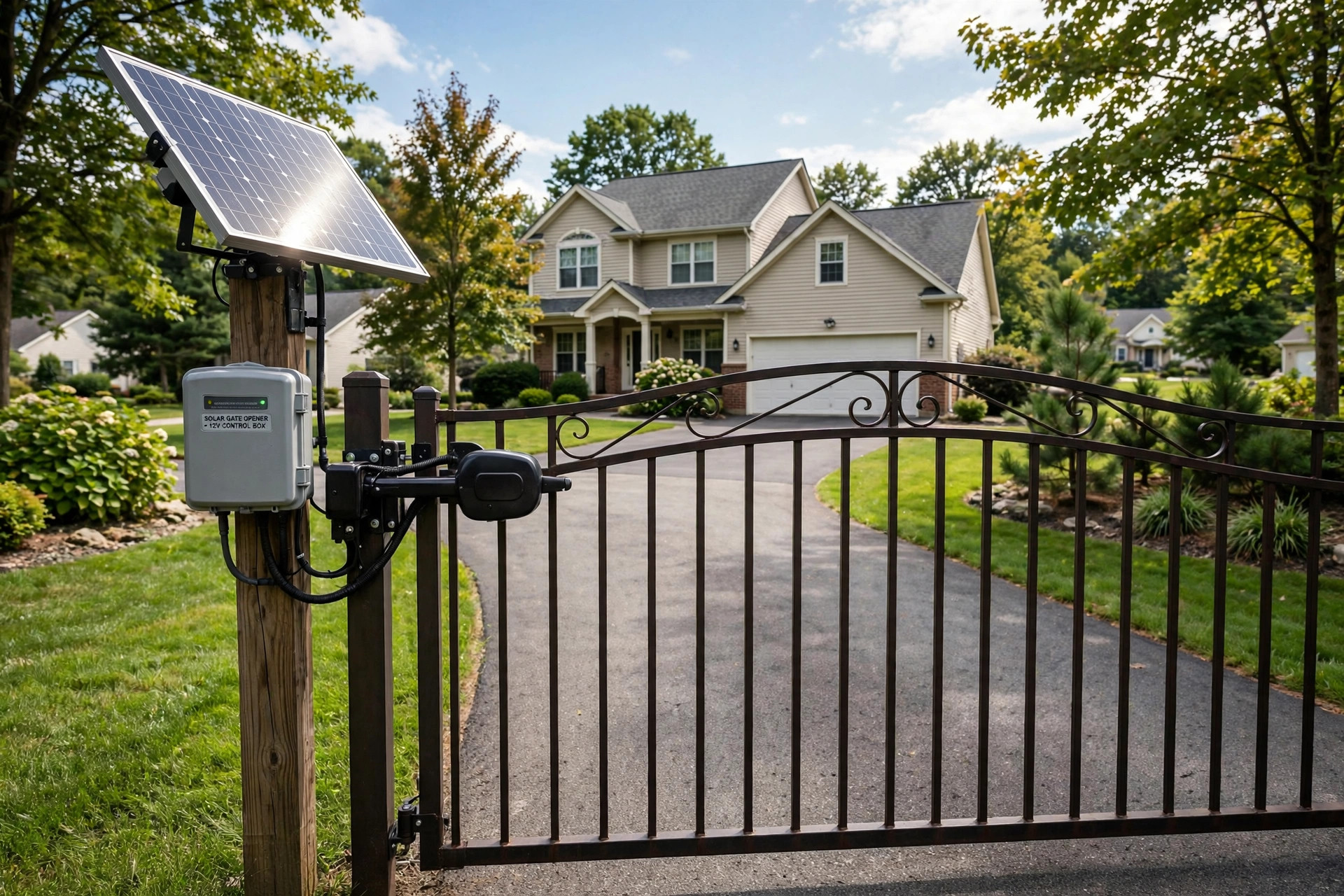

Homeowners who read solar gate opener reviews for driveway usa listings often share the same worry. They want a gate that opens and closes on its own. They do not want to trench a wire across the yard. A solar gate opener solves that problem. The sun charges a battery. The battery drives the gate. No electrician is needed. No monthly power bill grows.
This guide covers what these openers do, how they work, and what matters before you buy. It is written for homeowners in the United States who own a driveway gate and want honest facts.
Why a Solar Gate Opener Matters
A driveway gate does more than look fine. It keeps the yard private. It keeps pets in and strangers out. It adds value to the home. A gate that needs a push by hand loses much of this value. Rain, cold, and late nights make manual gates a burden.
A solar gate opener takes the effort away. You press a button from the car. The gate swings or slides open. You drive through. The gate closes behind you on a timer. That is the whole job.
Reviews for driveway use in the United States stress three points. First, reliability in winter. Second, battery life through cloudy weeks. Third, honest range of the remote control. A model that fails any of these three becomes a source of complaint instead of comfort.
Solar models matter most for gates far from the house. Many rural driveways stretch hundreds of feet. Trenching wire costs hundreds of dollars per hundred feet. Solar removes that cost. The opener sits at the gate. The panel faces the sun. The job is done.
How a Solar Gate Opener Works: Solar Gate Opener Reviews for Driveway Usa
The system has four parts. A solar panel. A control box with a battery. An electric motor arm. A remote receiver.
The panel turns sunlight into charge. The battery stores it. The motor pulls or pushes the gate arm. The remote tells the control box when to act. Most kits include two remotes and a keypad option.
A good kit also includes safety gear. Most reviews mention photocells. These are small sensors on both sides of the gate. If a car or child blocks the beam, the gate stops or reverses. This feature is not a luxury. In the United States, gate operators must meet safety standards, and the Consumer Product Safety Commission offers guidance on automated gate safety.
Battery size decides how many cycles the gate can run on a dark day. A single swing gate on a short driveway may need only a few cycles per day. A busy farm gate may need dozens. Reviews that rate openers well almost always praise strong battery capacity.
What to Look for Before You Buy
Reviews in the USA point to the same checklist. Read it before you spend money.
Gate weight and length. Every opener has a weight limit and a length limit. Measure your gate. A 300-pound limit means nothing if your gate weighs 380 pounds. Wind load counts too. A solid wood gate catches wind like a sail. A chain link or picket gate lets wind through.
Swing or slide. Swing gate openers use an arm on each leaf. Slide gate openers use a chain or rack on a rolling gate. Make sure the kit matches your gate style. A swing kit will not drive a sliding gate.
Solar panel wattage. Most kits ship with a 10 to 20 watt panel. Hot sunny states need less. Cloudy northern states need more. Some buyers add a second panel for safety. Check reviews from your region before you decide.
Battery backup. Look for a 12-volt deep-cycle battery, often 7 to 12 amp-hours. Larger batteries ride through storms. Sealed batteries need less care.
Remote range. Honest reviews test this. Some claim 300 feet and deliver 100. Thick walls, trees, and metal buildings cut the range. Buyers in farm country should read this line twice.
Access options. A keypad lets guests and workers enter with a code. Some models add a phone app. App control works through a hub and needs a data link, so check your signal at the gate first.
Warranty. Two to five years is normal for the motor. Panels often carry longer coverage. Read the fine print about weather damage.
For a fuller picture of driveway security gear, our guide to the best driveway motion sensor alarm reviews usa pairs well with this one.
Types of Solar Gate Openers
Single Swing Arm Openers
These fit one-leaf gates that swing open. They are the most common home choice. The arm mounts between a post and the gate. One motor pulls the gate open. Installation is simple enough for a handy owner. Most kits handle gates up to 16 feet and 600 pounds.
Dual Swing Arm Openers
Two arms drive two gate leaves. These suit wide driveways with double gates. The control box runs both motors in sequence. Cost runs higher. Reviews note that timing between the two leaves matters. If one leaf drags, the other waits.
Sliding Gate Openers
Sliding kits mount a motor at the gate post and a chain or rack on the gate. They suit heavy gates and sloped driveways where swing gates would drag. The motor must be bolted to a concrete pad. Installation takes more work, but reviews rate them as very steady once set.
Heavy Duty Solar Openers
Farm and ranch gates need more muscle. Heavy duty kits handle gates over 1,000 pounds. They ship with bigger panels, often 30 watts or more, and larger batteries. Price jumps, but so does dependability. ADT and SimpliSafe both note in their security guides that a dependable gate is the first layer of perimeter defense.
Cost and Price
Solar gate opener kits in the USA range from about 250 dollars to over 1,500 dollars. The price tracks the motor strength, the panel size, and the extras in the box.
A basic single swing kit for a light gate costs 250 to 450 dollars. These include a 10-watt panel, one battery, two remotes, and safety photocells. Reviews rate them well for light residential use.
A mid-range dual swing or sliding kit costs 500 to 900 dollars. These add a stronger motor, a larger panel, and often a keypad. Most suburban homes land in this range.
Heavy duty kits cost 1,000 to 1,500 dollars or more. They drive long ranch gates and include big batteries and panels.
Installation adds cost if you hire help. A professional install runs 300 to 800 dollars depending on the gate and the site. Many owners do it themselves in a day. Posts must be level and set in concrete. That is the hard part.
Want the full installed number? See our breakdown of the best automatic driveway gate cost installed.
Installation Steps in Plain Order
First, set the posts. They must be plumb and firm. A wobbly post ruins the whole job.
Second, mount the control box and battery near the gate. Keep it off the ground. Keep it dry.
Third, mount the solar panel. Face it true south in the continental United States. Tilt it to your latitude. Keep trees and roof lines clear of it.
Fourth, mount the motor arm or slide drive. Follow the manual for arm angle. A wrong angle strains the motor.
Fifth, wire the panel, battery, and motor to the control box. Use the wire gauge the manual calls for.
Sixth, set the open and close limits. The gate must stop short of the posts.
Seventh, install the photocells and test them. Block the beam. The gate must stop.
Eighth, program the remotes and keypad. Test from your car at the road.
Reviews on CNET and PCMag stress one point. Do not rush the limits step. A gate that slams its stops will shake the posts loose in a season.
Care and Upkeep
A solar gate opener asks for little. Give it a little anyway.
Check the battery voltage twice a year. A healthy 12-volt battery reads near 12.6 volts at rest. Replace the battery every three to five years. Reviews warn that most “dead opener” complaints are just old batteries.
Clean the solar panel with a soft cloth and water twice a year. Dust and pollen cut output. In winter, brush off snow.
Oil the gate hinges and the arm joints once a year. A stiff hinge makes the motor work hard. A hard-working motor dies young.
Check the safety photocells monthly. Wipe the lenses. Walk through the beam and watch the gate stop.
Trim plants away from the gate path. A gate that fights a bush will burn out its clutch.
In fall, clear leaves from the slide track or the swing area. Wet leaves freeze into lumps that block the gate.
Safety Rules
Automated gates can hurt people. Treat them with respect.
Keep children away from a moving gate. Never let a child ride or climb on the gate.
Mount controls at least five feet above the ground. This keeps small hands off the keypad and remotes.
Test the reversal system monthly. Place a soft object in the gate path. The gate must stop or reverse on contact. If it does not, cut the power and call for service.
Keep the manual release key where an adult can reach it. If power fails, you must open the gate by hand.
Do not stand in the gate path. Do not reach through the gate to grab a remote. These sound obvious. Reviews still record injuries from both.
The Consumer Product Safety Commission has logged gate injuries over the years. Its safety material is worth a read before you install.
Smart Features Worth Having
Newer openers add smart control. A cellular or Wi-Fi hub lets you open the gate from a phone. You get alerts when the gate opens. You can give a guest a timed code.
Before you pay for smart features, check the signal at your gate. Walk out with your phone. If the signal is weak, the smart hub will be weak too. A cellular hub needs its own plan in some kits. Read the fine print.
Camera add-ons are growing in popularity. A camera at the gate shows who is there before you open. Our review of the smart gate opener with camera reviews usa covers that option in detail.
Ring and the Google Store both sell driveway cameras that pair well with a gate, though they do not make gate openers themselves. The Verge has covered the rise of phone-controlled gates in smart home roundups.
What Reviewers Like and Dislike
Good reviews repeat the same praise. Easy install. Strong battery. Remotes that work from the road. Quiet motor. Clear manual.
Bad reviews repeat the same complaints. Weak panel in winter. Remotes with short range. Plastic gears that strip. Manuals written in broken English. Poor support when the motor fails.
One pattern stands out. Buyers who match the opener to their gate weight write happy reviews. Buyers who buy the cheapest kit for a heavy gate write angry reviews. Size the opener for the gate you own, not the gate you wish you owned.
Consumer Reports advises buyers of home equipment to check warranty terms and support ratings before purchase. That advice fits gate openers well.
FAQ
How much sun does a solar gate opener need? Most kits need four to six hours of direct sun per day. A 10-watt panel on a gate used a few times daily does fine in most of the USA. In the Pacific Northwest or the Northeast, a 20-watt panel or a second panel is the safer pick.
Will it work in winter? Yes, with limits. Cold slows batteries. Short days cut charging. Heavy use in a dark week can drain the battery. A larger battery and a larger panel fix most winter complaints. Keep the panel clear of snow.
Can I open the gate by hand if power fails? Yes. Every opener has a manual release. You turn a key or pull a lever. The gate then swings free. Keep the key where you can find it.
How long does the battery last? Three to five years for a sealed lead-acid battery. Heat shortens the life. Deep drains shorten it too. A battery kept charged lasts longest.
Do I need a permit to install one? Rules vary by town and county. Some areas ask for a permit for electrical work, even solar. Some homeowner associations have gate rules. Check before you buy.
Can a solar opener handle a double gate? Yes. Buy a dual kit with two arms and a control box that runs both. Make sure your power supply is sized for two motors. Reviews note that dual kits draw more, so a bigger panel helps.
A Short Final Word
A solar gate opener is a simple machine doing a simple job. It opens the gate. It closes the gate. The sun pays the power bill. Reviews for driveway use in the USA show that buyers stay happy when they size the kit right, face the panel at the sun, and keep the battery fresh.
Measure your gate. Count your daily cycles. Pick a kit with room to spare. Then enjoy the small pleasure of never getting out of the car in the rain again.
References
ADT. (n.d.). Home security and automation. https://www.adt.com CNET. (n.d.). Technology news and reviews. https://www.cnet.com Consumer Reports. (n.d.). Product reviews and ratings. https://www.consumerreports.org Google Store. (n.d.). Smart home devices. https://store.google.com PCMag. (n.d.). Technology product reviews. https://www.pcmag.com Ring. (n.d.). Smart home security devices. https://www.ring.com SimpliSafe. (n.d.). Home security systems. https://www.simplisafe.com The Verge. (n.d.). Technology news and reviews. https://www.theverge.com U.S. Consumer Product Safety Commission. (n.d.). Product safety information. https://www.cpsc.gov
Was this guide helpful?

About Lisa Anderson
The My Garden US editorial team writes practical, in-depth home and garden guides for American homeowners — tested advice, no fluff.
You May Also Like
Best Doorbell Transformer for Smart Doorbell: A Plain Buyer’s Guide
June 12, 2026 0 views
Best Smart Blinds Reviews 2026 USA
March 26, 2026 1 views
The Best Leak Detector for Washing Machine USA Homes
June 4, 2026 0 views