When you search for solar path lights for sale usa, you will find hundreds of choices. Some cost two dollars. Some cost forty. Some shine bright for ten hours. Some fade after three. This guide will help you tell the good ones from the poor ones before you spend your money.
Why It Matters
A dark path is a hazard. Guests trip. Delivery drivers miss the house. Burglars like dark corners. A row of small solar path lights fixes all three problems at once, and it costs almost nothing to run.
Solar path lights work on their own. A small panel on top of each light takes in sunlight during the day. A battery inside stores that energy. When the sun goes down, a sensor turns the light on. When the sun comes up, it turns off. There is no wiring to run. There is no switch to remember. There is no electric bill.
That is why solar path lights for sale usa are so popular with homeowners. You can buy a set on Saturday morning and have it working in your yard by Saturday night. No electrician is needed. No tools beyond your hands are needed for most models.
There is another benefit that people often miss. Light makes a home look cared for. A lit path looks warm and inviting from the street. Real estate agents have said for years that good outdoor lighting adds curb appeal. Solar path lights are one of the cheapest ways to get that effect.
The market has grown fast. Ten years ago, most solar path lights were dim and short-lived. Today, the best ones give a steady, bright glow from dusk past midnight. Guides at The Spruce often rate solar path lights among the easiest outdoor upgrades a homeowner can make.
How to Choose: What to Look For: Solar Path Lights for Sale Usa
Not all solar path lights are built the same. Here is what to check before you buy.
Brightness
Brightness is measured in lumens. Cheap path lights give 5 to 10 lumens. That is a soft marker light, good enough to outline a path but not to light it clearly. Better lights give 20 to 50 lumens. Those will actually light the ground so you can see where you step.
Do not buy on looks alone. A pretty lantern shape means nothing if it gives only 6 lumens. Check the box or the listing for the lumen number. For a main walkway, aim for at least 15 lumens per light. For accent edges of a flower bed, 5 to 10 lumens is fine.
Battery and Run Time
The battery decides how long the light stays on. Most solar path lights use one rechargeable AA or AAA battery. Nickel-metal hydride batteries last longer than nickel-cadmium ones. Some newer lights use lithium batteries, which hold a charge best of all.
A full day of sun should give 8 to 10 hours of light. That covers the whole night in most of the year. If a product promises 12 hours, read the reviews. In real use, 8 hours is a strong result. Information from ENERGY STAR notes that solar lighting works best when panels get full, direct sun for most of the day.
Panel Size
The solar panel is the engine of the light. Bigger panels catch more sun and charge faster. Look at the top of the light. A tiny coin-sized panel will struggle. A panel that covers most of the top will do far better. This one detail tells you more than most of the sales copy.
Build and Weather Resistance
These lights live outside in rain, snow, and heat. Check for a weather rating. IP44 is the minimum you should accept. IP65 is better and stands up to heavy rain. Glass lenses outlast plastic ones, which can turn cloudy after a year in the sun. Metal stakes hold better in hard ground than thin plastic stakes.
Retailers like Lowe’s and Home Depot list the weather rating in the product details. If a listing hides it, that is a warning sign.
Light Color
Path lights come in warm white, cool white, and multicolor. Warm white, around 2700K to 3000K, looks like old-fashioned lamplight. It suits brick paths and wooden decks. Cool white, around 5000K to 6000K, looks bright and modern. It suits concrete and stone. Pick one color and use it along the whole path. Mixed colors look messy.
Spacing
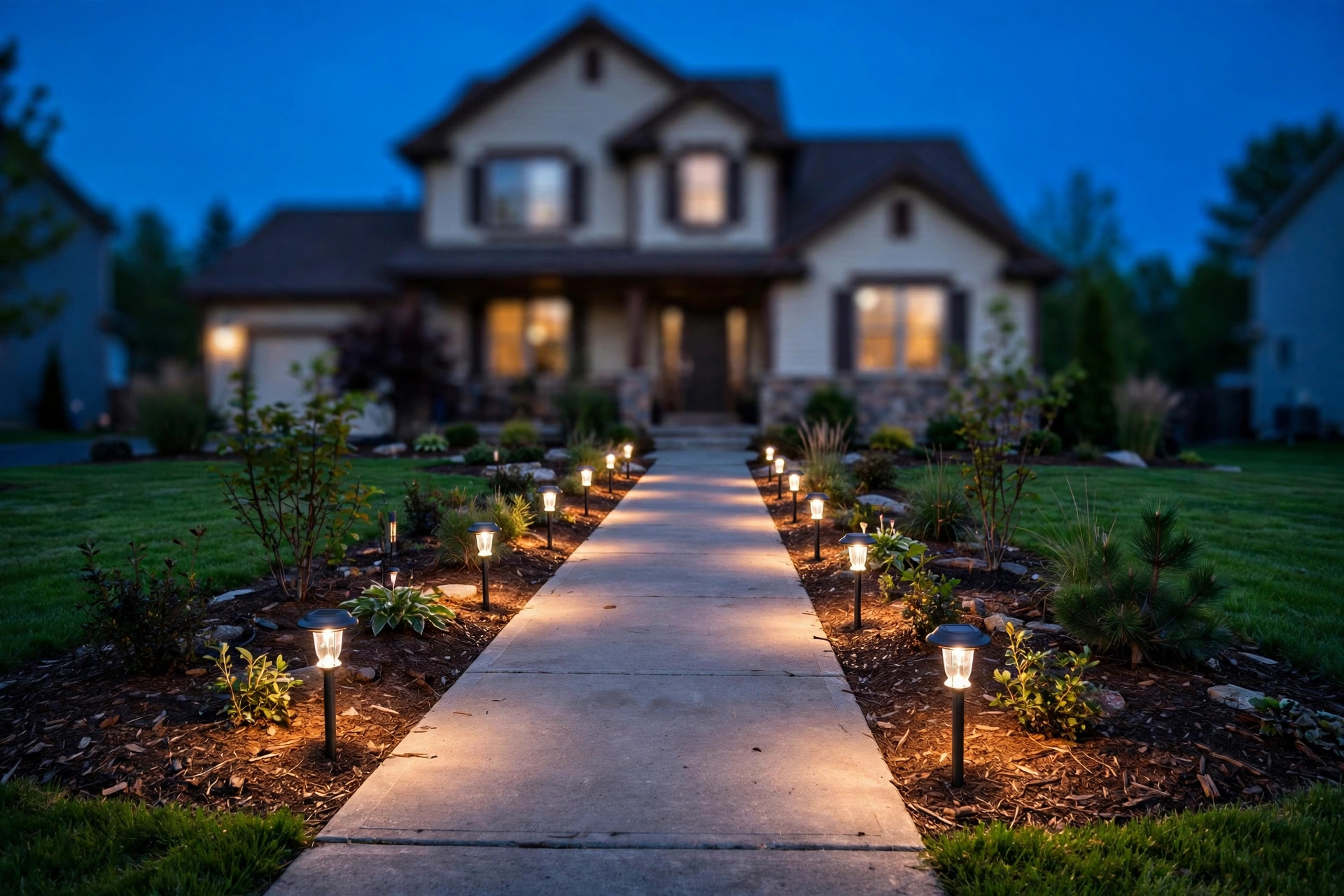
One light does not light a path. Plan on one light every 6 to 8 feet, set a foot or two back from the edge of the path. For a 30-foot walkway, that means four to five lights. Buy a few extra. A spare stake or two in the garage will save you a trip later.
Types and Options
When you shop solar path lights for sale usa, you will meet several styles. Each fits a different job.
Stake lights are the classic kind. A pointed stake goes into the ground, and the light head sits on top. They are the cheapest and the easiest to move. Most sets of six or eight are stake lights.
Lantern path lights look like small old-time lanterns. They give a softer, wider glow and suit traditional homes. They cost more but look better in a formal garden.
Flat disk lights sit flush with the ground. You cannot trip on them, and a mower can pass over them. They work well along driveways and lawn edges. Their light points straight up, so they mark a line more than they light the ground.
Motion-sensor path lights stay dim until someone walks by, then brighten. This saves battery and startles intruders. They are a good pick for side gates and back paths you use at night.
String-style solar lights are not true path lights, but some buyers use them along fences above a path. If you like that look, see our guide to indoor wall sconces where to buy usa for more ideas on matching outdoor and indoor lighting styles.
For deck edges and steps, deck cap lights for texas homes usa cover a related option that mounts on posts instead of going in the ground.
Cost and Price
Solar path lights for sale usa cover a wide price range. Here is what your money buys.
Budget sets, $15 to $30 for 6 to 8 lights. These are fine for marking a garden edge. Expect 5 to 10 lumens, plastic stakes, and one to two years of life. Many buyers are happy with them for the price.
Mid-range sets, $30 to $70 for 6 to 8 lights. This is the sweet spot for most homes. You get 15 to 30 lumens, better batteries, glass or thick plastic lenses, and metal stakes. These often last three to five years.
Premium lights, $10 to $40 each. Sold singly or in pairs. Expect 50 lumens or more, lithium batteries, IP65 ratings, and five-year warranties. Brands covered by Philips and specialists at Lumens and Lamps Plus sit in this tier.
Where you buy matters less than what you buy, but big retailers make returns easy if a set fails in the first season. The U.S. Department of Energy advises buyers to compare total cost over the life of the product, not just the sticker price. A $50 set that lasts five years is cheaper than a $20 set you replace twice.
Watch out for fake reviews on discount sites. If every review is five stars and written in the same week, be careful. Buy from sellers with a clear return policy.
Installation: A Simple Job
Installing solar path lights is one of the easiest home projects there is. Most people finish in under an hour.
1. Charge the lights first. Put them in full sun for a full day before you install them. Many come with the battery half-charged, and a full first charge helps battery life. 2. Plan the line. Lay the lights on the ground where you want them. Step back and look. Adjust until the spacing looks even. 3. Soften the ground if needed. After rain is ideal. If the ground is hard, push a screwdriver in first to make a pilot hole. Do not hammer the light itself. You will crack the stake. 4. Push the stakes in straight. The solar panel should face up and, if possible, toward the south for the most sun. 5. Keep panels clear of shade. This is the most common mistake. A light under a tree branch or a roof overhang will not charge. Move it two feet into the sun and the problem is solved.
That is the whole job. There is no wiring, no trenching, and no permits. If you can push a stake into soil, you can install solar path lights.
For buyers who want app control and timers, wifi smart bulbs for sale usa covers the indoor side of smart lighting, which pairs well with a solar-lit yard.
Care and Upkeep
Solar path lights need little care, but a little care keeps them bright for years.
Clean the panels. Dust, pollen, and bird droppings block sunlight. Wipe each panel with a damp cloth every month or two. In dusty areas, do it monthly. A dirty panel is the top cause of dim lights.
Replace the batteries. Rechargeable batteries wear out after one to three years. When lights fade early in the night even after cleaning, the battery is likely done. Most lights open with a small screw. Swap in the same type and size of rechargeable battery. Do not use regular throwaway batteries.
Check the stakes. Frost can push stakes out of the ground. Walk the line each spring and push loose lights back down. Replace cracked stakes before the light head ends up in the mower path.
Mind the seasons. In northern states, short winter days mean shorter run times. This is normal. The lights will run longer again in spring. If snow covers the panels, brush it off.
Store spares inside. If you buy extra lights, keep them in a dry place. Sunlight degrades plastic even in the box, so a garage shelf beats a sunny shed.
Safety
Solar path lights are low voltage and very safe, but a few points are worth noting.
Do not place lights where a mower or trimmer will hit them. A broken lens leaves sharp edges. Set lights at least a foot back from the grass edge.
Keep the path itself clear. Lights mark the way, but they do not remove ice, wet leaves, or toys left on the steps. Clear the walk as part of your routine.
If you live near the coast, salt air corrodes cheap metal parts fast. Choose stainless steel or heavy plastic housings, and rinse them with fresh water a few times a year.
Buy lights with proper certifications. Look for marks like UL, ETL, or CE on the box. These show the product passed safety tests. Uncertified lights from unknown sellers can have poor wiring that overheats, though this is rare with low-voltage solar products.
Frequently Asked Questions
How long do solar path lights last? The light fixture itself usually lasts three to five years. The battery needs replacing every one to three years. Premium lights with lithium batteries and glass lenses can last seven years or more with basic care.
Do solar path lights work in winter? Yes, but for fewer hours. Short days and low sun mean less charging. In the far north, expect four to six hours of light on a December night. The lights still help during the early evening when you need them most.
Do they work on cloudy days? They charge more slowly, but they still charge. Panels take in diffuse light through clouds. After two or three dark days in a row, run time drops. One sunny day brings them back.
Can I leave them out in the rain? Yes, if they carry a weather rating of IP44 or higher. That is the standard for outdoor use. Avoid lights with no rating printed on the box. Standing water is harder on them than rain, so do not place them where puddles form.
How many lights do I need for my walkway? Count on one light every 6 to 8 feet. A typical 24-foot front walk needs three to four lights. Longer or curved paths need more. Buy one extra as a spare.
Are expensive solar path lights worth it? For a main path you use every night, yes. Brighter light, longer run time, and a five-year life make the cost per year lower than cheap sets. For a back garden bed you rarely visit, budget sets are fine.
A Final Word
Shopping for solar path lights for sale usa does not need to be hard. Decide how bright you need the path, pick lights with good batteries and a real weather rating, and put the panels where the sun hits them. Do that, and a modest set of lights will serve you well for years. Clean the panels now and then, swap the batteries when they fade, and your path will greet you with light every night.
References
ENERGY STAR. (n.d.). Energy efficient products. https://www.energystar.gov Lamps Plus. (n.d.). Lighting and home decor. https://www.lampsplus.com Lowe’s. (n.d.). Home improvement products. https://www.lowes.com Lumens. (n.d.). Lighting and ceiling fans. https://www.lumens.com Philips. (n.d.). Lighting products. https://www.philips.com The Home Depot. (n.d.). Home improvement products. https://www.homedepot.com The Spruce. (n.d.). Home and garden advice. https://www.thespruce.com U.S. Department of Energy. (n.d.). Energy efficiency and renewable energy. https://www.energy.gov
Was this guide helpful?

About Michael Thompson
The My Garden US editorial team writes practical, in-depth home and garden guides for American homeowners — tested advice, no fluff.