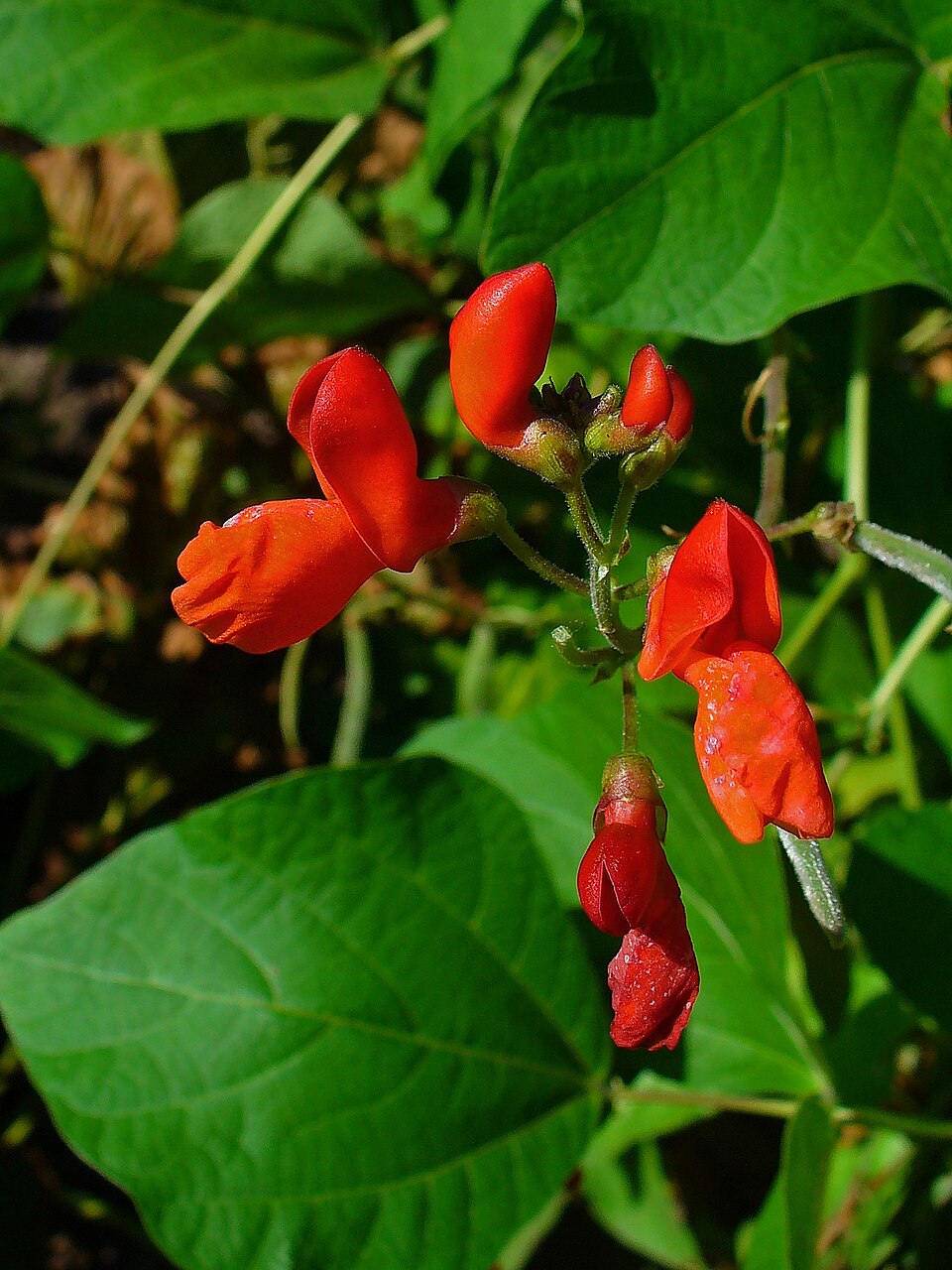
Scarlet runner beans - Phaseolus coccineus - are the vegetable garden's best argument that food plants can be beautiful. The vines climb eight feet or more, the brilliant red flowers draw hummingbirds all summer, and the harvest is genuinely good eating: young pods like green beans, mature beans for drying. Learning how to grow scarlet runner beans gives you an ornamental screen, a pollinator magnet, and a productive crop from a single planting.
Table of Contents
Table of Contents
These are vigorous climbers with old-world charm - they have been grown in British cottage gardens for centuries as much for looks as for food. The Missouri Botanical Garden plant profiles cover scarlet runner beans as an ornamental edible worth the trellis space. In America they deserve wider planting, especially where gardeners want a fast summer screen that also feeds the family. Give them a very sturdy trellis, warm soil, and consistent water, and they do the rest with enthusiasm.

Photo: Wikimedia Commons
Getting Started: A Bean That Climbs Like It Means It
When it comes to how to grow scarlet runner beans, getting the details right makes all the difference.

Many homeowners find that how to grow scarlet runner beans is easier than they expected once they know the basics.
Scarlet runners are warm-season annuals in most of the country, hardy in zones 3 through 10 as a summer crop - though they are actually tender perennials where winters are mild, resprouting from the roots. They prefer cool summers to hot ones, an unusual trait: they flower most heavily when temperatures are moderate and can stall in extreme heat. The USDA PLANTS database notes their mountain origins in Central America, which explains the cool-summer preference.
The vines are genuinely vigorous - thicker and stronger than common pole beans - and they need a very sturdy trellis or tepee at least 8 feet tall. Flimsy supports bend and collapse under a mature planting. Think 4x4 posts, cattle panels, or a stout arbor, not bamboo canes. This is infrastructure, and building it right the first time saves a mid-season rescue operation.
Seed is large and easy to handle - big white or mottled beans that even children can sow. Varieties include the classic red-flowered type, plus white-flowered and bicolored forms. The red is the hummingbird magnet; the others are pretty but less magnetic.
When and How to Plant
Many homeowners find that how to grow scarlet runner beans is easier than they expected once they know the basics.
The key to how to grow scarlet runner beans is choosing the right approach for your space and budget.
Direct sow after all danger of frost has passed - about two weeks after your last spring frost, when the soil has warmed. The Almanac planting calendar helps you find that frost date and count forward to safe sowing. Scarlet runners are warm-season beans; frost kills seedlings outright, and cold, wet soil rots the big seeds. There is no advantage to rushing - a week of patience beats replanting. If you want to check your USDA zone planting dates, our planting calendar will help you find that frost date.
Sow 1 to 2 inches deep and 6 inches apart at the foot of the trellis. The seeds germinate in about a week in warm soil. In short-season northern zones, you can start seeds indoors in large pots a few weeks early - but transplant carefully, since beans resent root disturbance, and only to gain a couple of weeks. Most gardeners direct sow and do fine.
From sowing to first pods runs about 70 to 90 days, with flowers appearing weeks earlier - the hummingbird show starts long before the harvest. In hot climates, sow as early as warmth allows so the plants flower during the milder part of summer; extreme heat causes blossom drop. The Old Farmer's Almanac warm-season planting guidance applies: soil warmth first, calendar second.
Soil and Sun
The key to how to grow scarlet runner beans is choosing the right approach for your space and budget.
With a little planning, how to grow scarlet runner beans can fit even a busy schedule.
Full sun is best - six to eight hours for heavy flowering and podding. In the hottest zones, afternoon shade actually helps: it keeps the vines cooler during the worst heat and extends the flowering season. This is one of the few beans where a little shade in the South is a feature, not a compromise.
Moderately fertile, well-drained soil suits them. Like all beans, runners fix their own nitrogen, so heavily manured soil grows enormous vines with fewer pods - average fertility is the sweet spot. Work in compost at planting for structure and moisture retention, then stop. Good drainage matters; the big seeds rot in waterlogged spring soil.
A near-neutral pH is ideal. If your soil is very acidic, a light liming helps the nitrogen-fixing bacteria do their work. Inoculating the seed with bean inoculant - the beneficial bacteria - boosts early growth in soils where beans have never grown, a cheap insurance policy available wherever seeds are sold.
Watering and Feeding
With a little planning, how to grow scarlet runner beans can fit even a busy schedule.
Before you start, it helps to understand how how to grow scarlet runner beans works in real homes.
Keep the soil consistently moist, especially while flowers are setting - drought at flowering causes blossom drop, the most common yield-killer. A deep watering once or twice a week, plus mulch to hold moisture, is the program. The vines drink heavily in summer; a mature planting on a hot day moves a lot of water.
Do not feed with nitrogen - the plants fix their own, and excess nitrogen delays flowering in favor of vine. If the soil is poor, the compost at planting is enough. Pale young plants sometimes need a one-time boost, but established runners in decent soil want nothing but water.
Mulch heavily with straw once the vines are up. The mulch keeps roots cool and moist - runners appreciate cool roots even more than most beans, a legacy of their mountain origins - and keeps developing pods clean where vines sprawl near the ground. The University of Minnesota Extension bean-growing guides emphasize consistent moisture at flowering for all bean types.
Care Through the Season
Before you start, it helps to understand how how to grow scarlet runner beans works in real homes.
A good plan for how to grow scarlet runner beans saves time, money, and frustration.
Train the young vines onto the trellis. They climb by twining, and they find the support on their own - but a gentle initial guidance toward the trellis saves tangles. Once they catch on, they race upward. Check weekly and redirect any vines heading for the neighbor's fence or your tomatoes.
Watch for Japanese beetles and aphids, the two main pests. Japanese beetles skeletonize the leaves in midsummer where they are a problem - handpick into soapy water in the cool of the morning, when they are sluggish. Aphids cluster on new growth and flower buds; blast with water. Avoid broad-spectrum insecticides on a plant whose whole point includes hummingbird flowers - the Clemson Home and Garden Information Center stresses protecting pollinators on flowering crops.
In hot climates, provide afternoon shade to extend flowering - a shade cloth on the west side, or siting the trellis where a building shades it after midday. Heat-induced blossom drop is the main limit on southern production; every degree of cooling helps. Some southern gardeners grow runners as a fall crop, sowing in late summer for autumn flowering when temperatures moderate - a clever inversion worth trying.
Enjoy the hummingbirds. The red flowers are among the best hummingbird attractors in the vegetable garden, and a blooming runner-bean trellis becomes a wildlife feature. This alone justifies the planting for many gardeners.
Harvest
A good plan for how to grow scarlet runner beans saves time, money, and frustration.
For most people, how to grow scarlet runner beans comes down to a few smart choices.
Pick young pods under 6 inches long for eating fresh - at this stage they cook like green beans, tender and sweet. Slice and steam, sauté with garlic, or add to stir-fries. Overlooked pods get stringy and tough fast, so harvest every day or two at peak season. Picking young and often also keeps the plant flowering - the standard bean bargain: the more you pick, the more it produces.
Or let pods mature fully and shell the large beans for drying. The dried beans - big, handsome, mottled or white - cook into hearty dishes and store for months in airtight jars. They need thorough cooking like all dried beans. A single trellis can produce pounds of dried beans alongside the summer's fresh pods.
In mild-winter zones, the perennial roots survive - mulch the crown heavily in fall and the plant resprouts in spring, bigger and earlier each year. A third-year runner bean crown is a formidable thing, flowering weeks ahead of seed-grown plants. In colder zones, pull the vines after frost and compost them. Like cucumbers grown for both fresh eating and storage, runners give you two harvests from one planting.
Troubleshooting
For most people, how to grow scarlet runner beans comes down to a few smart choices.
If you are new to how to grow scarlet runner beans, start with the simplest option and build from there.
Seeds rotted. Cold, wet soil - you sowed too early. Wait for real warmth, sow at proper depth, and in heavy spring soil, plant on slight ridges. Pre-sprouting indoors between damp towels lets you plant only viable sprouts.
Flowers dropping, no pods. Heat, drought, or both - the classic runner bean complaint. Water consistently, provide afternoon shade in hot zones, and consider a late-summer sowing for fall production. UF/IFAS Gardening Solutions has warm-climate bean guidance for southern growers facing the same heat.
Japanese beetles skeletonizing leaves. Handpick into soapy water mornings and evenings. Row cover excludes them but also excludes the hummingbirds and pollinators - use it only on young plants before flowering, then remove.
Vines collapsed the trellis. The classic runner bean lesson. Rebuild with 4x4 posts or cattle panels - this vine is stronger than it looks. Prune the vines back by a third to reduce the load while you rebuild. Gardenia.net growing guides warn about support strength for vigorous climbers.
Aphids on the buds. Blast with water, encourage ladybugs, and pinch off the worst clusters. The flowering will outpace minor infestations.
Scarlet runner beans are the ornamental edible at its best - a screen, a hummingbird garden, and a bean crop in one planting. The USDA National Agricultural Library documents their centuries as a cottage-garden favorite. Build the trellis strong, sow when the soil warms, and enjoy the reddest flowers in the vegetable garden.
References
If you are new to how to grow scarlet runner beans, start with the simplest option and build from there.
When it comes to how to grow scarlet runner beans, getting the details right makes all the difference.
- Clemson University Cooperative Extension. (n.d.). Home & garden information center. https://hgic.clemson.edu/
- Gardenia. (n.d.). Scarlet runner bean growing guide. https://www.gardenia.net/
- U.S. Department of Agriculture. (n.d.). PLANTS database. https://plants.usda.gov/home
- University of Minnesota Extension. (n.d.). Growing beans in home gardens. https://extension.umn.edu/
- USDA National Agricultural Library. (n.d.). Agricultural library resources. https://www.nal.usda.gov/
Many homeowners find that how to grow scarlet runner beans is easier than they expected once they know the basics.
When it comes to how to grow scarlet runner beans, getting the details right makes all the difference.
Many homeowners find that how to grow scarlet runner beans is easier than they expected once they know the basics.
Was this guide helpful?

About My Garden US
The My Garden US editorial team writes practical, in-depth home and garden guides for American homeowners — tested advice, no fluff.
You May Also Like
Peat Pots Seedlings USA Online Deals: A Plain Guide for Home Gardeners
August 23, 2026 16 views
How to Grow Motherwort: Full Planting Guide
November 18, 2026 0 views
How to Grow Cumin in Hot Climates
November 17, 2026 6 views