String lights turn a plain room into a warm one. Draped over a headboard, along a mantel, or around a mirror, they add glow for little money. But they are still electrical products, and indoor misuse causes real fires. Learning how to use string lights indoors safely lets you enjoy the look without the risk. The rest of this guide covers how to use string lights indoors safely in plain language.
Table of Contents
Table of Contents
- How to Use String Lights Indoors Safely: Start With the Right Lights
- The Core Safety Rules
- How to Hang Them Without Damage
- Room-by-Room Guidance
- Indoor vs. Outdoor Lights: Can You Swap?
- Timers, Smart Plugs, and Dimmers
- What the Standards Say
- Storage Between Uses
- Quick Safety Checklist
- String Lights and Your Home's Style
- Frequently Asked Questions
- References
This guide covers choosing safe lights, hanging them without damage, electrical rules, and the mistakes that cause most problems.
How to Use String Lights Indoors Safely: Start With the Right Lights
When it comes to how to use string lights indoors safely, getting the details right makes all the difference.
Many homeowners find that how to use string lights indoors safely is easier than they expected once they know the basics.
Not all string lights belong indoors. Check the package for an indoor rating. Indoor-rated lights meet standards for home use. Outdoor lights may not, and using them inside is a needless risk. Guides to indoor string light safety stress this as step one.
Look for a UL listing or equivalent certification mark on the box and the cord tag. UL 588 is the U.S. safety standard for seasonal and decorative lighting. It covers shock and fire safety through testing of wiring, plugs, and insulation JJR Lab's UL 588 standard overview. No mark, no buy.
Choose LED over incandescent. LEDs run far cooler and draw far less power. An old incandescent mini-bulb strand can get hot enough to scorch fabric. An LED strand stays cool to the touch. For indoor use, that temperature difference is the whole safety story. Fifty LED bulbs at a fraction of a watt each total around 10 watts, while incandescent strands run much hotter Home of Strings' indoor hanging guide.
Buy from known brands. The cheapest unbranded strands often have thin wiring and weak insulation. A mid-priced UL-listed set from a real brand costs little more and is far safer.
The Core Safety Rules
Many homeowners find that how to use string lights indoors safely is easier than they expected once they know the basics.
The key to how to use string lights indoors safely is choosing the right approach for your space and budget.
Inspect before you hang. Every time, not just the first time. Look for frayed wires, cracked sockets, loose bulbs, and bent plugs. If you find damage, throw the strand out. Do not repair it with tape.
Never overload outlets. Check the maker's limit on how many strands you can connect end to end. Daisy-chaining too many strands overheats wiring. When in doubt, use fewer strands and a second outlet. A power strip with overload protection beats a basic extension cord.
Keep lights away from flammables. Curtains, bedding, paper garlands, and dried flowers all burn. Keep at least a foot of space between bulbs and anything flammable. Never drape lights directly over a bed or sofa. Hang them overhead with clips or hooks instead Home of Strings on fire risks.
Turn them off when you leave. Use a timer or smart plug so lights shut off automatically. Never sleep with decorative lights on unless they are specifically rated for it. Lights left on overnight cause a large share of decorative-lighting fires Wavesold's string light fire hazard guide.
Do not cover them. Never tuck lights under blankets, inside fabric shades not made for them, or behind boxed-in displays. Trapped heat is the enemy. Transformers and plugs need air too.
How to Hang Them Without Damage
The key to how to use string lights indoors safely is choosing the right approach for your space and budget.
With a little planning, how to use string lights indoors safely can fit even a busy schedule.
Nails and staples are the classic mistake. They pierce wire insulation and create shorts and fire hazards. Use methods made for the job.
Adhesive hooks and clips. Small clear hooks stick to walls and trim and hold light strands neatly. They remove cleanly. Use enough of them so the strand does not sag and pull.
Tension rods and curtain rods. A rod across a window or alcove carries lights with no wall damage at all. Drape the strand over the rod for a soft swag.
Ceiling tracks and picture rails. For a permanent look, mount a slim track or use an existing picture rail. Secure the wire every two to three feet so it cannot sag and stress the connections.
Command-style strips. For lightweight fairy lights, adhesive strips on the back of small clips work well on smooth walls.
Run cords where feet will not find them. Never run a cord under a rug, through a doorway, or under heavy furniture. Pinched cords overheat and fray. Route along baseboards with cord clips or hide cords in paintable raceways Home of Strings' cord management tips.
Room-by-Room Guidance
With a little planning, how to use string lights indoors safely can fit even a busy schedule.
Before you start, it helps to understand how how to use string lights indoors safely works in real homes.
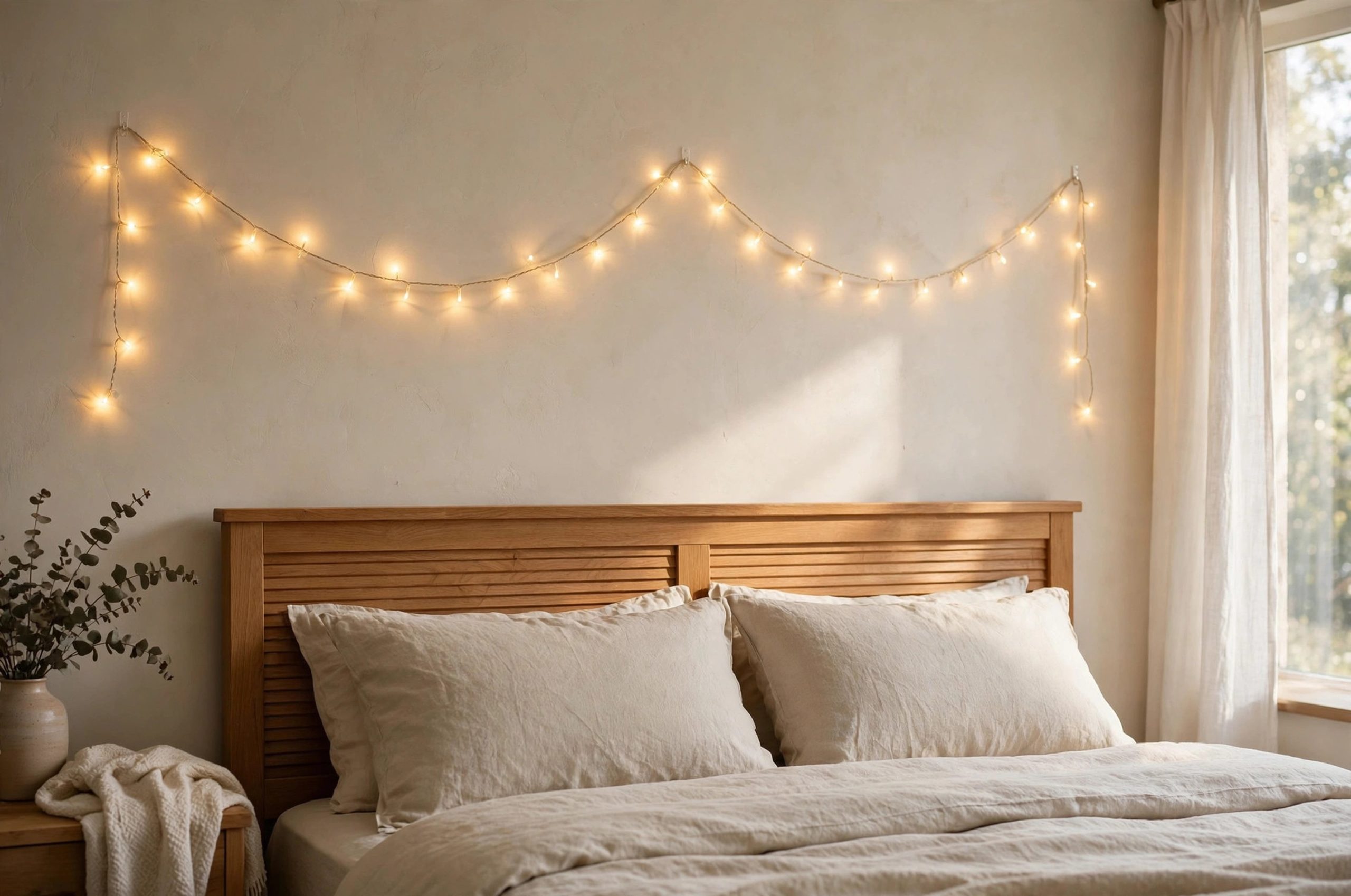
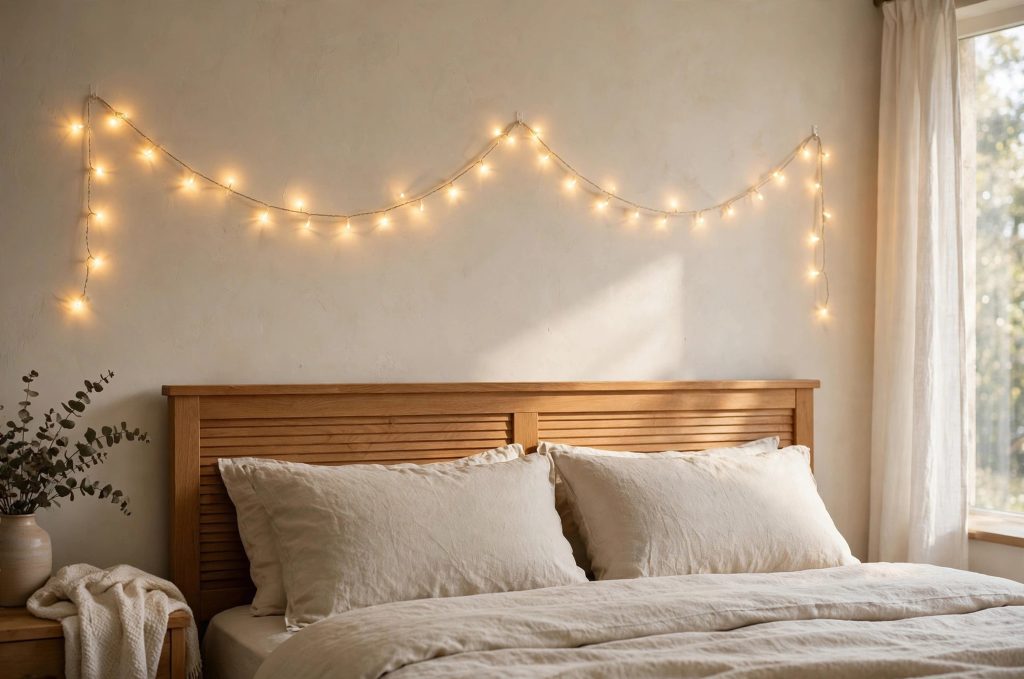
Bedroom. The most popular room for string lights and the one needing the most care. Hang them on the wall or headboard, never across pillows or blankets. Use a timer so they shut off after you fall asleep. Keep them clear of curtains. Globe lights hung in a canopy pattern give a dreamy look with safe spacing Home of Strings' globe light hanging guide.
Living room. Mantels, bookshelves, and mirror frames are natural spots. Keep strands off the fireplace itself and away from candles. If lights share an outlet with the TV and consoles, check the total load.
Kids' rooms. Use low-voltage LED fairy lights only. Keep strands out of reach of small children who chew cords. Battery-operated LED strands remove the outlet risk entirely and are the safest pick for nurseries.
Dining room and entryway. A strand along a sideboard or around a doorway adds warmth for gatherings. Keep them clear of table candles and out of the path of swinging doors.
Around plants. Lights woven through houseplants look great, but keep bulbs off dry leaves and water the plants normally. Do not let the strand sit in a wet saucer.
Indoor vs. Outdoor Lights: Can You Swap?
Before you start, it helps to understand how how to use string lights indoors safely works in real homes.
A good plan for how to use string lights indoors safely saves time, money, and frustration.
Outdoor string lights are built tougher, but tougher does not mean indoor-safe. Some outdoor lights lack the indoor rating and its specific tests. If you want the chunky cafe-bulb look inside, buy a set rated for indoor use. The rating matters more than the look Home of Strings on using outdoor lights indoors.
That said, many quality LED sets carry both indoor and outdoor ratings. Check the tag. If it lists indoor use, you are fine.
Timers, Smart Plugs, and Dimmers
A good plan for how to use string lights indoors safely saves time, money, and frustration.
For most people, how to use string lights indoors safely comes down to a few smart choices.
A timer is the cheapest safety upgrade. A simple plug-in timer costs a few dollars and guarantees the lights never burn all night. Smart plugs add phone control and schedules. Set lights to fade on at dusk and off at bedtime.
Do not dim a non-dimmable strand. If you want dimming, buy dimmable LEDs and a compatible dimmer. Flicker and buzz signal a mismatch.
For holiday-style displays that stay up for weeks, a smart plug with a daily schedule is the set-and-forget answer. It also saves power.
What the Standards Say
For most people, how to use string lights indoors safely comes down to a few smart choices.
UL 588 covers seasonal and decorative lighting for temporary use, generally up to 90 days. It tests for electric shock, fire from short circuits, and mechanical strength. Products that pass carry the UL mark. Amazon and other marketplaces require this testing for light strings they sell JJR Lab on UL 588 testing for light strings.
Treat long-term indoor displays with the same respect. Even LED strands age. Replace strands that show wear, and do not leave any decorative lighting up year-round without periodic inspection.
General holiday light safety checklists from electricians echo the same points: inspect, do not overload, keep clear of flammables, and use timers.
Storage Between Uses
If you are new to how to use string lights indoors safely, start with the simplest option and build from there.
Coil strands loosely around cardboard or a cord reel. Tight wrapping stresses wires. Store in a cool, dry place in a sturdy container. Tangled storage causes most of next season's damage. Before rehanging, inspect again. A strand that was fine last season may have cracked insulation from storage.
Quick Safety Checklist
When it comes to how to use string lights indoors safely, getting the details right makes all the difference.
- Indoor-rated, UL-listed LED lights only
- Inspect every strand before hanging; discard damaged ones
- Hang with hooks and clips, never nails or staples
- Keep bulbs a foot or more from curtains, bedding, and paper
- Do not run cords under rugs or through doorways
- Respect the maker's limit on connected strands
- Use a timer or smart plug; off when you sleep or leave
- Never cover lights with fabric or box in transformers
- Store coiled loosely in a dry place
String Lights and Your Home's Style
Many homeowners find that how to use string lights indoors safely is easier than they expected once they know the basics.
Once safety is handled, have fun with placement. String lights layer well with other lighting. In the living room, pair them with the picks in our living room floor lamps buying guide. For stairway garlands with lights, see our fall garland with lights guide. Outdoors, our magnetic grill light reviews cover task lighting for the patio.
Frequently Asked Questions
Are string lights safe to leave on overnight? No, unless specifically rated for it. Use a timer so they turn off when you sleep.
Can I use outdoor string lights indoors? Only if the tag lists indoor use. Buy sets rated for indoor use to be safe.
How many strands can I connect together? Follow the maker's stated limit, often three to five strands for LEDs. Never exceed it.
Are LED string lights safer than incandescent? Yes. LEDs run cooler and draw far less power, which cuts both fire and overload risk.
Can I hang string lights with staples? No. Staples and nails can pierce insulation and cause shorts. Use adhesive hooks or clips.
Do I need to unplug them when I leave the house? A timer or smart plug that shuts them off works just as well and is easier to stick with. Keep this guide handy the next time how to use string lights indoors safely comes up.
References
Bonfe. (n.d.). Holiday lights safety tips: Preventing fire and electrical hazards. https://bonfe.com/blog/holiday-lights-safety-tips-preventing-fire-and-electrical-hazards/
Home of Strings. (n.d.). Are string lights safe indoors? Find out the truth. https://homeofstrings.com/are-string-lights-safe-indoors/
Home of Strings. (n.d.). Can outdoor string lights be used indoors safely and stylishly? https://homeofstrings.com/can-outdoor-string-lights-be-used-indoors/
Home of Strings. (n.d.). How to hang globe string lights indoors for cozy ambiance. https://homeofstrings.com/how-to-hang-globe-string-lights-indoors/
Home of Strings. (n.d.). What to hang string lights with indoors: Creative ideas for cozy ambiance. https://homeofstrings.com/what-to-hang-string-lights-with-indoors/
JJR Lab. (n.d.). Amazon light string UL588 testing. https://www.jjrlab.com/news/amazon-light-string-ul588-testing.html
JJR Lab. (n.d.). LED strip EU CE-EN 60598, USA UL 588 certification. https://www.jjrlab.com/news/led-strip-eu-ce-en-60598-usa-ul-588-certification.html
Wavesold. (n.d.). Are string lights a fire hazard? Exploring the safety implications and precautions. https://www.wavesold.com/are-string-lights-a-fire-hazard/
Was this guide helpful?

About My Garden US
The My Garden US editorial team writes practical, in-depth home and garden guides for American homeowners — tested advice, no fluff.