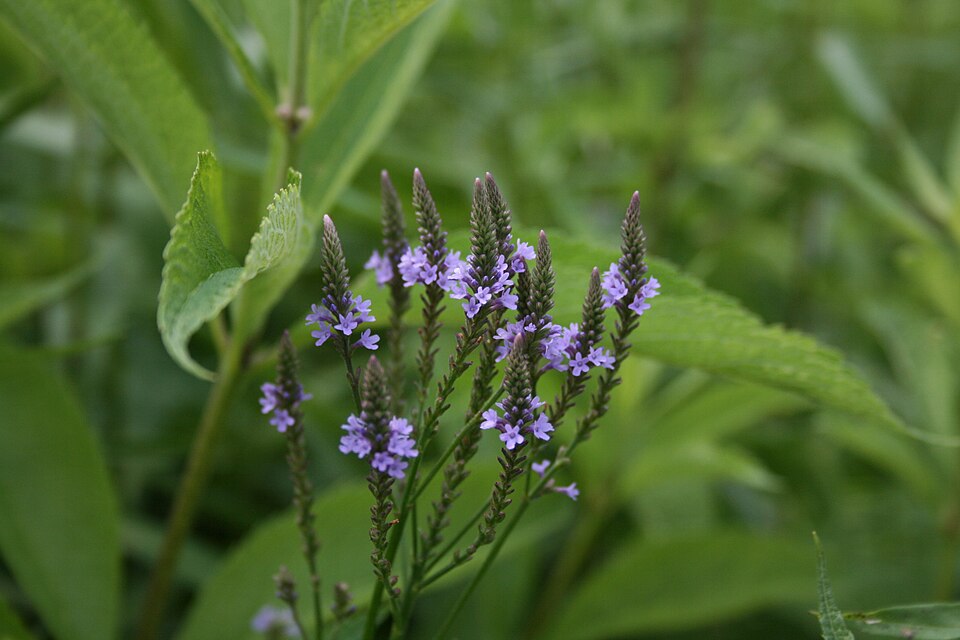
Blue vervain - Verbena hastata - is the native wildflower for the wet spot where nothing else thrives. Where the yard dips and the soil stays soggy, where the downspout empties and the rain garden fills, this plant stands four to five feet tall with branching candelabra spikes of tiny blue-violet flowers, feeding bees and butterflies for weeks. Learning how to grow blue vervain is about matching a plant to its place: give it the damp ground it evolved for, and it takes care of the rest.
Table of Contents
Table of Contents
This is a plant with deep American roots - it grows wild in wet meadows and along stream banks across much of the continent - and it brings that wild resilience to the garden. It is also a traditional herb, harvested for teas at the peak of bloom. Whether you grow it for pollinators, for the herb shelf, or simply because the wet corner needs something beautiful, the method is the same: chill the seed, plant it wet, and stand back.

Photo: Wikimedia Commons
Getting Started: A Native for Wet Ground
When it comes to how to grow blue vervain, getting the details right makes all the difference.

Many homeowners find that how to grow blue vervain is easier than they expected once they know the basics.
Blue vervain is a true North American native perennial, hardy in zones 3 through 8, and the Lady Bird Johnson Wildflower Center lists it among the most valuable native plants for wet soils and pollinator gardens. In the wild it colonizes pond edges, ditch banks, and rain gardens - anywhere the ground stays moist. That habitat tells you exactly where to plant it: the lowest, wettest spot you have.
The plant's architecture is distinctive: stiff, square stems rising to branching spikes that look like a candelabra, each branch lined with tiny blue flowers that open progressively from base to tip. It is not a blowsy, romantic flower - it is structural, almost architectural, and it looks best in drifts or at the back of a border where its height shows.
The seed needs a cold, moist chilling period - stratification - to germinate well. This is non-negotiable and the main reason beginners fail with it. You can provide the chill artificially (a month in damp sand in the refrigerator) or let winter do it by sowing outdoors in late fall. Either way, respect the seed's need for winter. From seed to flower usually takes until the second year - blue vervain is a plant that asks for patience and repays it for years.
When and How to Plant
Many homeowners find that how to grow blue vervain is easier than they expected once they know the basics.
The key to how to grow blue vervain is choosing the right approach for your space and budget.
Start seed indoors about eight weeks before your last spring frost, after giving it that month of cold-moist stratification in the refrigerator - sealed in damp sand or a damp paper towel in a bag. Sow the stratified seed on the surface of moist mix and press in lightly; it needs light to germinate. Keep it moist and be patient - germination is uneven even with stratification. If you want to check your USDA zone planting dates, our planting calendar will help you count back those eight weeks.
Transplant seedlings out around your last spring frost, spacing them 12 to 18 inches apart. The Almanac planting calendar helps you count back the indoor-start weeks from your frost date so the timing lands right. They look unremarkable at first - a rosette of toothed leaves - but they are building the root system that powers next year's five-foot spikes. Alternatively, direct sow stratified seed outdoors around the last frost date, or sow unstratified seed in late fall and let winter do the chilling naturally. The fall-sowing method is the simplest and often the most successful.
Do not expect flowers the first year. Blue vervain typically blooms in its second season, spending the first building roots. This surprises gardeners used to annuals, but it is normal for native perennials. The Old Farmer's Almanac notes that native perennials follow their own schedule - plant them, tend them, and let the second year bring the show.
Soil and Sun
The key to how to grow blue vervain is choosing the right approach for your space and budget.
With a little planning, how to grow blue vervain can fit even a busy schedule.
Full sun to partial shade suits it, with full sun giving the sturdiest stems and heaviest bloom. In the wild it grows in open wet meadows; in the garden, give it the sunniest wet spot you have. Shade makes it leggy and reduces flowering.
The soil should be moist to wet - this is the plant's defining requirement. Rain gardens, pond edges, low spots, the outlet of a downspout: these are blue vervain territory. It tolerates poor drainage that would kill lavender in a week, and it sulks in dry soil, wilting dramatically when the ground dries out. If your garden has no naturally wet spot, you can create one with a shallow basin and heavy mulch - but honestly, this is a plant to grow where the water already is.
No fertilizer is needed in decent soil. Rich feeding grows soft, floppy stems; the plant's native ground is not rich, just wet. A yearly mulch of shredded leaves holds moisture and feeds the soil gently - all the fertility it wants.
Watering and Feeding
With a little planning, how to grow blue vervain can fit even a busy schedule.
Before you start, it helps to understand how how to grow blue vervain works in real homes.
Keep the soil moist - always. This is the whole job. Blue vervain wilts in dry soil faster than almost any garden plant, and repeated wilting weakens it. In its proper wet site, rainfall handles the job; in a merely moist bed, water deeply during dry spells. Mulch heavily - three to four inches of shredded leaves or wood chips - to hold water in the root zone.
Never let a new planting dry out. The first season is when the deep root system establishes, and drought in year one can stunt the plant permanently. If you cannot commit to watering through dry spells, plant it only where the ground stays naturally wet.
No fertilizer beyond the mulch. This plant evolved in wet meadows, not fertilized beds, and excess nitrogen makes tall, weak stems that flop. If growth is truly pale and stunted - rare in decent soil - a light top-dressing of compost is the maximum intervention. The University of Minnesota Extension native-plant guides make the same point: natives want appropriate conditions, not pampering.
Care Through the Season
Before you start, it helps to understand how how to grow blue vervain works in real homes.
A good plan for how to grow blue vervain saves time, money, and frustration.
Deadhead if you do not want seedlings everywhere. Blue vervain self-sows freely in wet spots - a virtue if you want a colony, a nuisance if you want one plant. Snipping the spent spikes before seed ripens controls the spread; leaving them gives you drifts and feeds the goldfinches, who love the seeds. Many gardeners split the difference: deadhead the front of the planting, leave the back for the birds.
The branching spikes rarely need staking - the stems are stiff and self-supporting, one of the plant's virtues. In very rich soil they can get leggy; in proper lean, wet soil they stand straight. Cut the whole plant back after the first flush if you want a second, shorter bloom - it often reblooms modestly.
Few pests bother it. This is a native plant with native defenses, and the insect community mostly leaves it alone or visits as pollinators. Deer generally avoid it. The main "pest" is its own enthusiasm in wet soil - it spreads by seed into every damp corner. Site it where a colony is welcome, like the rain garden or pond edge, not in the middle of a formal perennial bed. The Missouri Botanical Garden notes its self-sowing habit as both virtue and warning.
Divide every three to four years if the clump gets congested, though established plants resent disturbance - division is for controlling spread, not for the plant's health. The Clemson Home and Garden Information Center has native-plant care notes covering self-sowing perennials like this one.
Harvest
A good plan for how to grow blue vervain saves time, money, and frustration.
For most people, how to grow blue vervain comes down to a few smart choices.
Harvest the flowering tops just as the tiny blue flowers open along the spikes - this is the peak moment for the traditional herbal harvest. Cut the top third of the flowering stems with sharp shears in the morning after the dew dries. Dry them quickly in a warm, airy spot out of direct sun; good air circulation matters more than heat. Store the dried herb in jars away from light.
For the garden's sake, harvest judiciously - take from the front of the planting and leave the back for pollinators and seed. The flowers feed bees, butterflies, and beneficial wasps for weeks, and the plant's wildlife value is one of its main reasons for being. Like sage grown for both kitchen and bees, blue vervain serves two masters well.
Leave the last seed heads standing through fall and winter. The goldfinches will thank you - they cling to the spikes and pick out the seeds - and the stiff stems give the winter garden structure. Cut everything to the ground in early spring before new growth starts.
Troubleshooting
For most people, how to grow blue vervain comes down to a few smart choices.
If you are new to how to grow blue vervain, start with the simplest option and build from there.
Nothing germinated. The seed did not get its cold-moist stratification. This is the number one failure with blue vervain. Stratify for a month in the fridge, or sow outdoors in late fall and let winter do it. Unstratified spring-sown seed mostly sits there.
First-year plants, no flowers. Normal. Blue vervain blooms in its second year. Tend the foliage, keep it watered, and wait - the spikes will come.
Plants wilt every afternoon. The soil is too dry for this plant. Water deeply, mulch heavily, and consider whether the site is really wet enough. Chronic wilting means wrong site, not wrong plant - move divisions to a wetter spot in fall.
It is taking over the rain garden. It self-sows enthusiastically in wet soil. Deadhead before seed ripens, pull seedlings where unwanted (they pull easily), and accept that a colony is the natural state of this plant. The USDA PLANTS database shows how readily it colonizes wet ground in the wild.
Stems flopping. Too much shade or too much fertility. Move toward full sun and stop feeding. In proper conditions the stems stand stiff without help. Gardenia.net growing guides note the same fix.
Blue vervain is the answer to the gardener's wet-spot question - the plant that turns a drainage problem into a pollinator paradise. The USDA National Agricultural Library holds the old herbals that made it famous and the modern native-plant guides that are bringing it back. Chill the seed, plant it wet, wait for year two, and enjoy the candelabras.
References
If you are new to how to grow blue vervain, start with the simplest option and build from there.
When it comes to how to grow blue vervain, getting the details right makes all the difference.
- Gardenia. (n.d.). Blue vervain growing guide. https://www.gardenia.net/
- Lady Bird Johnson Wildflower Center. (n.d.). Native plant database. https://www.wildflower.org/plants/
- Missouri Botanical Garden. (n.d.). Plant finder. https://www.missouribotanicalgarden.org/
- U.S. Department of Agriculture. (n.d.). PLANTS database. https://plants.usda.gov/home
- University of Minnesota Extension. (n.d.). Native plants for pollinators. https://extension.umn.edu/
Many homeowners find that how to grow blue vervain is easier than they expected once they know the basics.
The key to how to grow blue vervain is choosing the right approach for your space and budget.
When it comes to how to grow blue vervain, getting the details right makes all the difference.
Many homeowners find that how to grow blue vervain is easier than they expected once they know the basics.
The key to how to grow blue vervain is choosing the right approach for your space and budget.
Was this guide helpful?

About My Garden US
The My Garden US editorial team writes practical, in-depth home and garden guides for American homeowners — tested advice, no fluff.
You May Also Like
Wildflower Seed Mixes for California Homes: A Simple Guide
March 13, 2026 19 views
Tulip Bulbs Fall American Homes Guide: Planting for a Brighter Spring
July 28, 2026 22 views
How to Grow Damask Roses Successfully
November 2, 2026 17 views