---
Table of Contents
Table of Contents
- Seal Granite Countertops: Does Your Granite Need Sealing?
- The water test
- The oil test
- How Often to Reseal
- Choosing the Right Sealer
- What You Need
- Step 1: Deep Clean the Counter
- Step 2: Test the Sealer in a Hidden Spot
- Step 3: Apply the Sealer
- Step 4: Wipe Off the Excess
- Step 5: Let It Cure
- Daily Care After Sealing
- Common Sealing Mistakes
- Stains on Granite: What to Do
- Sealing Other Stone
- Frequently Asked Questions
- Can you seal granite yourself?
- How long does granite sealer last?
- Will sealer change the color of my granite?
- Is granite sealer food-safe?
- References
Granite is tough, but it is not waterproof. The stone is naturally porous, which means liquids can seep in and leave stains. Sealer fills those tiny pores and buys you time to wipe up spills before they mark the stone.
Sealing granite is one of the easiest home jobs there is. It takes less than an hour of actual work. Here is how to seal granite countertops the right way, from testing to curing.
Seal Granite Countertops: Does Your Granite Need Sealing?
When it comes to seal granite countertops, getting the details right makes all the difference.
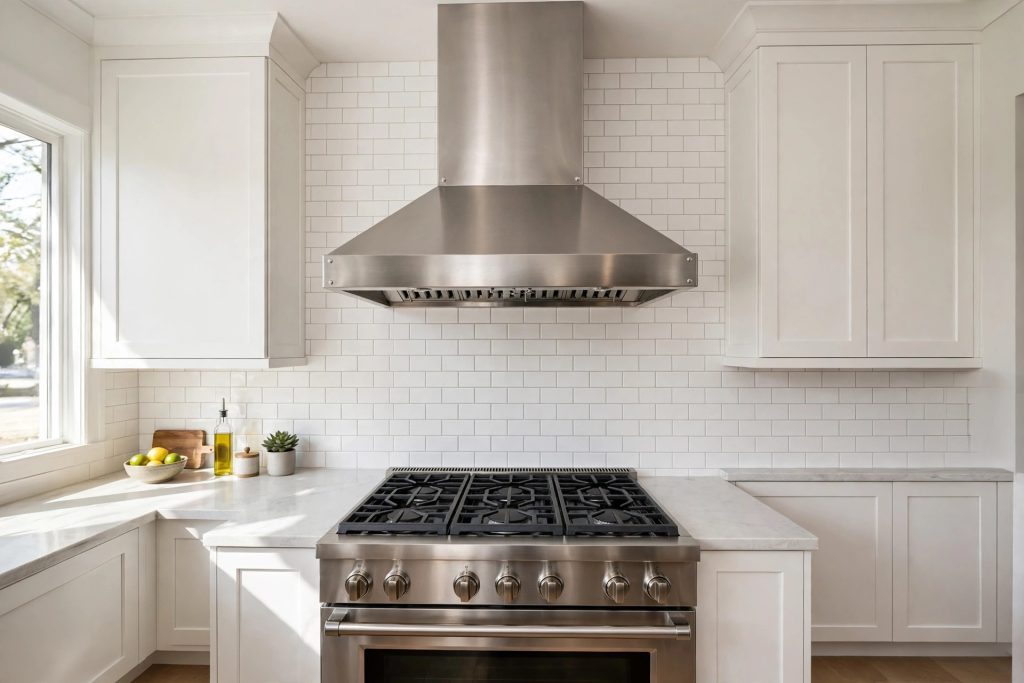
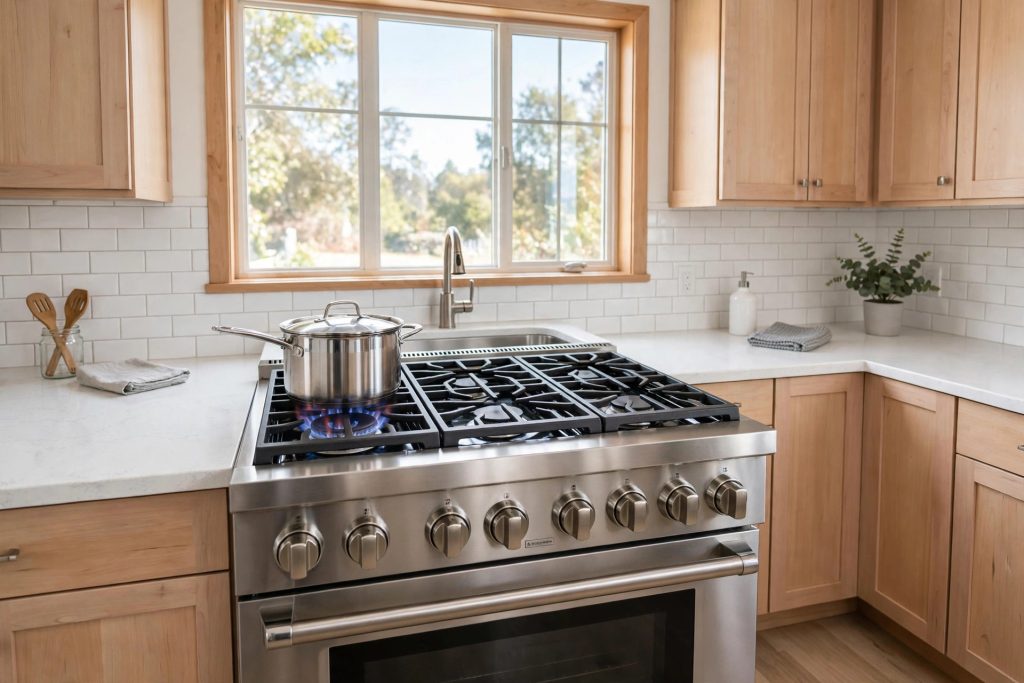
Many homeowners find that seal granite countertops is easier than they expected once they know the basics.
Not all granite needs sealer right now. Some slabs are dense and were sealed at the factory. Others are thirsty and need help. Test before you buy sealer.
The water test
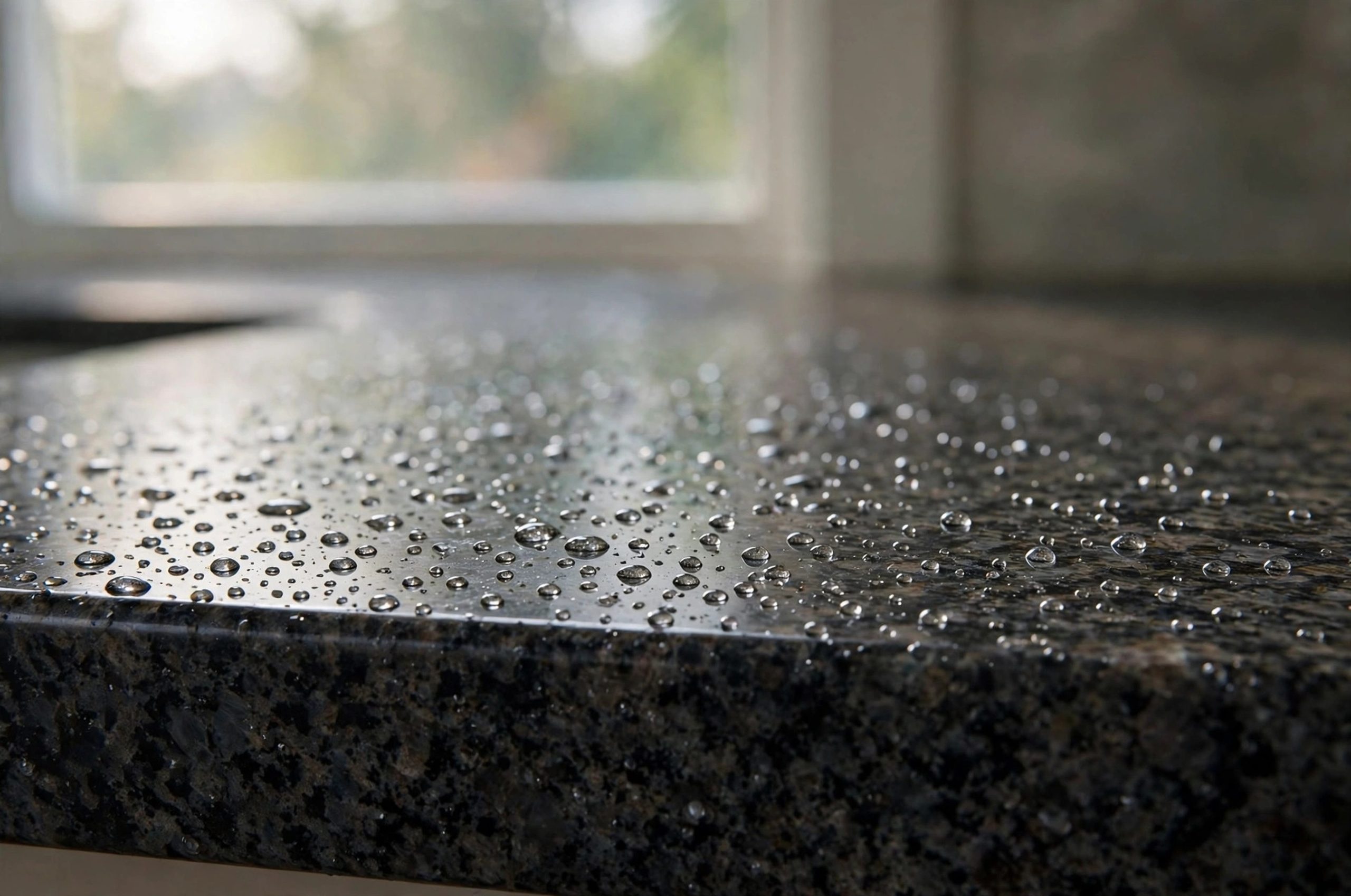
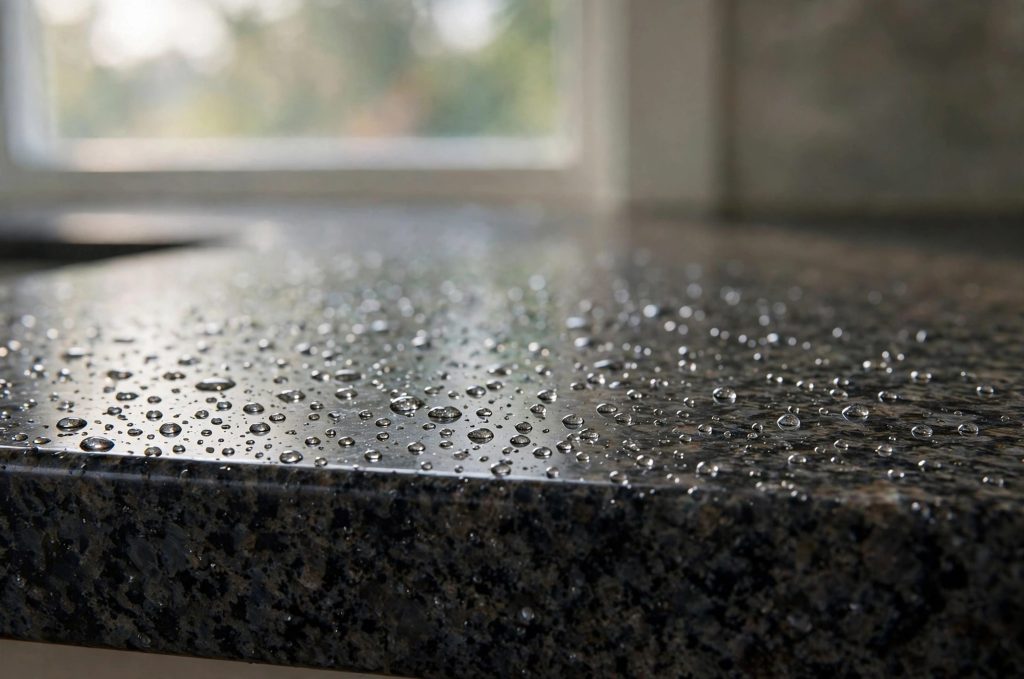
Pour a small puddle of water, a few inches across, onto the counter in several spots. Let it sit for 30 minutes. Then wipe it up.
- If the water beads up, the seal is intact. You do not need to seal now.
- If the water soaks in and leaves a dark spot, the stone is absorbing liquid. Time to seal.
This simple test is the standard check recommended by stone care pros and sealer makers alike (Granite Gold, n.d.; Real Homes, n.d.).
The oil test
Water tests for water absorption. Oil is a different threat. Repeat the test with a few drops of cooking oil or mineral oil. If the oil darkens the stone, your sealer is not blocking oils well. A quality penetrating sealer handles both.
Dark granite often needs sealer less than light granite. Lighter stones tend to be more porous and show stains more easily. But color is only a rough guide. Trust the water test, not the color.
How Often to Reseal
Many homeowners find that seal granite countertops is easier than they expected once they know the basics.
The key to seal granite countertops is choosing the right approach for your space and budget.
There is no single schedule. It depends on the stone, the sealer, and how hard you use the kitchen.
Sealer makers generally suggest resealing every 6 to 12 months in busy kitchens (Granite Gold, n.d.). Stone care guides give a wider range, from every six months to every few years depending on the product (Angi, n.d.). Factory-sealed slabs can go much longer.
The honest answer: test once or twice a year and seal when the water test says so. A calendar schedule is a guess. The water test is a fact.
Choosing the Right Sealer
The key to seal granite countertops is choosing the right approach for your space and budget.
With a little planning, seal granite countertops can fit even a busy schedule.
Buy a penetrating sealer made for natural stone. Penetrating sealers soak into the pores and block liquids from inside. They do not sit on top like a coating, so they do not peel or change the look of the stone.
Avoid topical coatings sold as granite sealers. They sit on the surface, wear unevenly, and can turn cloudy. Also avoid generic waterproofing sprays not made for stone. They may not be food-safe.
Look for a sealer labeled safe for food-prep surfaces. Water-based formulas are low-odor and easy to use. Solvent-based formulas can penetrate deeper but need more ventilation.
Popular options include Granite Gold Sealer, a spray-and-wipe formula made by a stone care company (DK Hardware, n.d.), and similar penetrating sealers from stone care brands. Any quality stone sealer works if you apply it right.
What You Need
With a little planning, seal granite countertops can fit even a busy schedule.
Before you start, it helps to understand how seal granite countertops works in real homes.
- Penetrating granite sealer
- Stone-safe cleaner or mild dish soap
- Microfiber cloths (several)
- Plastic wrap or painter's tape (optional, to protect nearby surfaces)
Step 1: Deep Clean the Counter
Before you start, it helps to understand how seal granite countertops works in real homes.
A good plan for seal granite countertops saves time, money, and frustration.
Sealer locks in whatever is on the stone. Clean first.
Wipe the whole counter with a stone-safe cleaner or a little dish soap and warm water. Get the grease off, especially near the stove. Rinse with a clean damp cloth.
For stuck-on grime, use a plastic scraper. Never use a metal scraper on granite. It can scratch the polish.
Let the counter dry fully. Sealer and water do not mix. If the stone is damp, the sealer cannot soak in. Give it at least an hour of drying, longer in humid weather.
Step 2: Test the Sealer in a Hidden Spot
A good plan for seal granite countertops saves time, money, and frustration.
Spray or wipe a small amount of sealer on an inconspicuous area, like behind a canister or near the backsplash. Let it sit per the label directions, then wipe it off.
Check for discoloration, haze, or stickiness. Most sealers are fine on granite, but this test takes a minute and rules out surprises.
Step 3: Apply the Sealer
For most people, seal granite countertops comes down to a few smart choices.
Work in sections. Spray the sealer evenly over a few square feet at a time. Make sure every inch is wet, with no dry spots. The stone should look evenly damp.
Let the sealer soak in for the time the label says. Most products want 15 to 20 minutes of dwell time. Do not let it dry on the surface. If a section starts drying, mist on a little more sealer to keep it wet.
Some stones drink sealer fast. If the first coat soaks in completely within minutes, apply a second coat while the first is still workable. Thirsty stone may need two or three coats.
Step 4: Wipe Off the Excess
If you are new to seal granite countertops, start with the simplest option and build from there.
This is the step people skip, and it causes most problems. After the dwell time, wipe the whole surface with a clean, dry microfiber cloth. Remove all the excess sealer.
Leftover sealer dries into a hazy, sticky film. It attracts dirt and looks worse than no sealer at all. Buff until the stone feels dry and looks clear. Flip the cloth to a clean side often.
If haze appears later, wipe the area with a little more sealer on a cloth. The fresh sealer dissolves the dried residue. Then buff dry again.
Step 5: Let It Cure
When it comes to seal granite countertops, getting the details right makes all the difference.
Sealer needs time to cure inside the stone. Keep the counter dry and unused for the time the label says. Many products ask for an hour before light touching and 24 hours before full use.
Do not clean the counter for a day or two after sealing. Water and cleaners interfere with curing. Plan the job for a time when the kitchen can rest, like before bed or before a day out.
Angi's sealing guide advises waiting as long as possible, up to two full days, for the best cure (Angi, n.d.).
Daily Care After Sealing
Many homeowners find that seal granite countertops is easier than they expected once they know the basics.
Sealer is not armor. It slows stains. It does not stop them. Good habits keep the seal working longer.
- Wipe spills fast. Sealer buys you time, not immunity. Blot spills instead of wiping, which spreads them.
- Use pH-neutral cleaners. Cleaners made for stone are best. Dish soap and water work for daily cleaning.
- Avoid acids. Vinegar, lemon juice, and citrus cleaners can etch stone and wear the seal down. Real Homes notes that acidic products dull the finish over time (Real Homes, n.d.).
- Use cutting boards and trivets. Never cut directly on granite. Use trivets under hot pots. Heat and blades damage stone and sealer alike.
- Use coasters. Rings from glasses are the most common granite stain. Coasters stop them.
Common Sealing Mistakes
Sealing dirty stone. The sealer traps grime under it. Clean thoroughly first.
Applying too much. More sealer is not better. Flooded sealer leaves haze. Thin, even coats are the goal.
Skipping the wipe-off. Dried excess is the top cause of cloudy, sticky counters after sealing.
Sealing too often without testing. You cannot really over-seal, but sealing a stone that is already sealed wastes product and risks buildup. Test first.
Using the wrong product. Tile sealer, concrete sealer, and wood finish are not granite sealer. Use a product made for natural stone.
Stains on Granite: What to Do
If a stain appears despite sealing, act fast. Blot the spill. Clean with a stone-safe cleaner.
For set stains, a poultice can pull the stain out. A poultice is a paste, often baking soda and water, spread over the stain and covered with plastic wrap. It draws the stain up as it dries. Stone pros recommend poultices for stains that have sunk below the surface (Real Homes, n.d.).
Oil stains respond to baking soda poultices. Water spots and rings often fade with gentle buffing. If a stain will not lift, a stone care professional can hone and repolish the area.
Sealing Other Stone
These steps work for marble, travertine, limestone, and slate too. Marble and limestone are softer and more porous than granite, so they usually need sealing more often. Quartz, the engineered stone, does not need sealing at all. Its resin binder already blocks liquids.
If you are choosing counters, our guides to quartz countertop installation for California homes and butcher block countertops where to buy compare the options. For the wall behind the counters, see installing tile backsplash for beginners.
Frequently Asked Questions
Can you seal granite yourself?
Yes. It is one of the simplest DIY jobs. Clean, apply, wipe, and cure. No special tools or skills needed.
How long does granite sealer last?
It varies. Busy kitchens may need resealing every 6 to 12 months. Lighter use stretches it longer. The water test tells you when, better than any calendar.
Will sealer change the color of my granite?
A penetrating sealer should not change the color once cured. The stone looks darker while wet, then returns to normal. Always test in a hidden spot first.
Is granite sealer food-safe?
Sealers made for countertops are formulated to be safe on food-prep surfaces once cured. Let the sealer cure fully before prepping food directly on the stone.
References
Angi. (n.d.). How to seal granite countertops. https://www.angi.com/articles/how-seal-granite-countertop.htm?page=99
DK Hardware. (n.d.). Granite Gold GG0056 natural stone sealer. https://www.dkhardware.com/granite-gold-gg0056-natural-stone-sealer-commercial-and-residential-penetrating-6-pk-clear-product-5598736.html
DoItYourself.com. (n.d.). How to seal natural stone countertops. https://www.doityourself.com/stry/how-to-seal-natural-stone-countertops
Granite Gold. (n.d.). Granite countertop sealing guide. https://granitegold.com/blogs/blog/granite-countertop-sealing-guide
Hunker. (n.d.). How to seal stone countertops. https://www.Hunker.com/13724147/how-to-seal-stone-countertops/
Money Pit. (n.d.). Seal granite countertops yearly. https://www.moneypit.com/seal-granite-countertops-yearly/
Real Homes. (n.d.). How to seal a granite countertop. https://www.realhomes.com/advice/how-to-seal-granite
Realtor.com. (n.d.). How to seal granite countertops and protect this kitchen surface. https://www.realtor.com/advice/home-improvement/how-to-seal-granite-countertops/
Stone Dimensions. (n.d.). Sealing granite countertops: How to seal your natural stone. https://www.stonedimensions.com/post/sealing-granite-countertops-how-to-seal-your-natural-stone
Was this guide helpful?

About My Garden US
The My Garden US editorial team writes practical, in-depth home and garden guides for American homeowners — tested advice, no fluff.
You May Also Like

Kitchen Pantry Cabinets Deals Near Me: How to Find Real Savings Close to Home
January 14, 2026 14 views
Stainless Range Hoods Reviews: A Buying Guide for USA Homes
July 24, 2026 21 views
Quartz Countertop Installation for California Homes
September 25, 2026 22 views